
Connecting enterprise platforms with operational AI assurance.
ODA3 methods and evidence models are intended to complement enterprise platforms through structured interoperability, without replacing governance, workflow, incident or system-of-record capabilities.
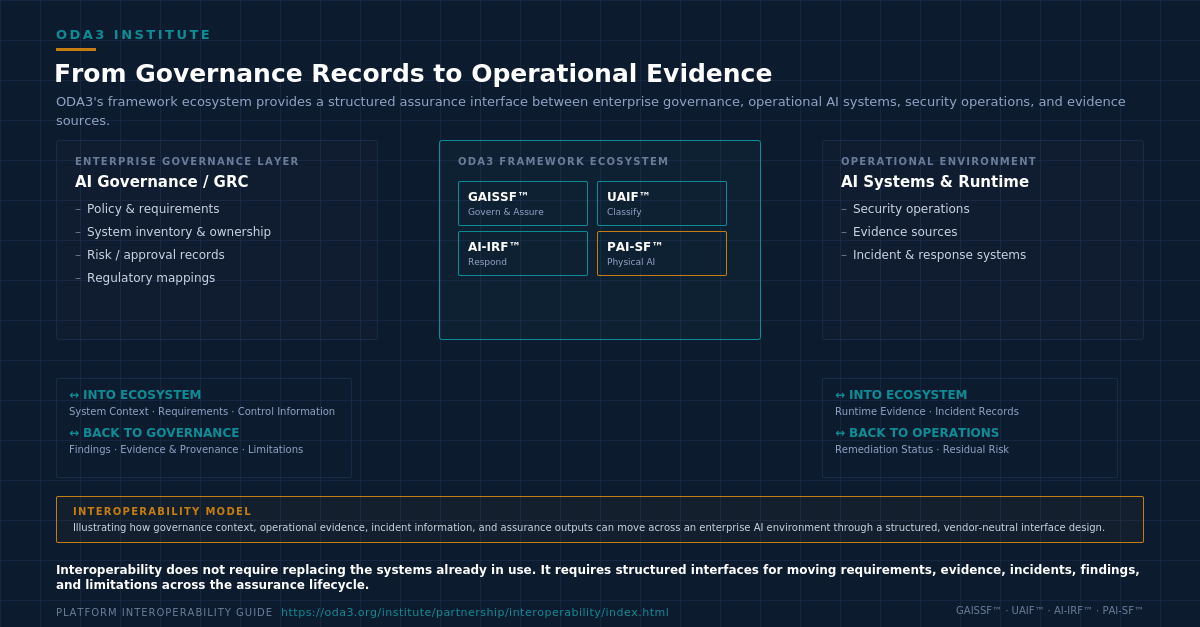
No mandatory platform, vendor or deployment model.
Integration does not change framework requirements.
Evidence remains attributable, traceable and under defined custody.
Platform output supports judgment; it does not replace it.
A vendor-neutral evidence path.
GRC · Workflow · ITSM · AI Governance
Illustrative conceptual architecture only. This is not implementation guidance and does not prescribe a technology stack.
| Enterprise capability | Potential ODA3 interaction |
|---|---|
| AI and asset inventory | Framework scope and control mapping |
| Risk registers | Evidence and decision-trace inputs |
| Workflow engines | Evidence requests, ownership and review steps |
| AI governance platforms | Framework references and structured evidence exchange |
| Incident systems | UAIF™ classification and AI-IRF™ response structures |
| Audit repositories | Assessment-ready evidence packages and traceability |
Framework Mapping
Map platform categories and records to ODA3 controls, incident fields or evidence expectations.
Evidence Exchange
Define structured export, reference packs or evidence hand-off without changing the partner's system of record.
Assessment Support
Prepare evidence for methodology-guided review while preserving independent judgment and decision authority.
Assessment support does not constitute assessment, certification, approval or endorsement.
- No mandatory platform or runtime agent.
- No required workflow engine.
- No exclusive integration model or vendor preference.
- No platform-specific certification.
- No representation that an API connector or production integration currently exists.
Technical interoperability should be validated through a scoped evaluation before broader deployment decisions are made.
If you need to determine whether a defined AI system and evidence base can support a specific assurance question, explore the ODA3 Evidence Readiness Pilot.