
ODA3-2026-07-INS-079
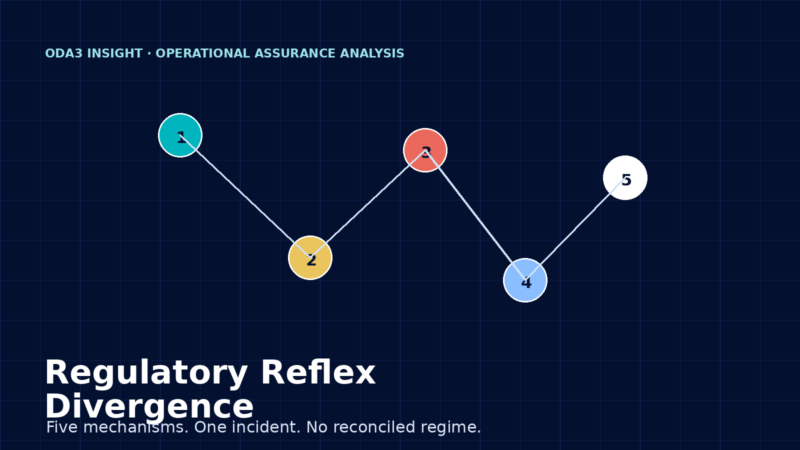
Regulatory Reflex Divergence
How One Frontier Model Security Incident Exposed Five Uncoordinated Governance Responses
Read publication →INSIGHTS
Explore AI security, assurance evidence, incidents, regulatory implementation, standards and Physical AI. Read each publication with its sources, scope and limits.
THE ARCHIVE
Search the archive here. Open a publication from its result card, without visiting a second archive page.
Search published articles by title, publication ID or recorded category. Filter by document family or year, then open the published article from its result card.
Search results are retrieval matches, not evidence-tier judgments.
Open to read. A published article does not by itself establish an assessment or certification of a system.
127 matching publications.
ODA3-2026-07-INS-079
How One Frontier Model Security Incident Exposed Five Uncoordinated Governance Responses
Read publication →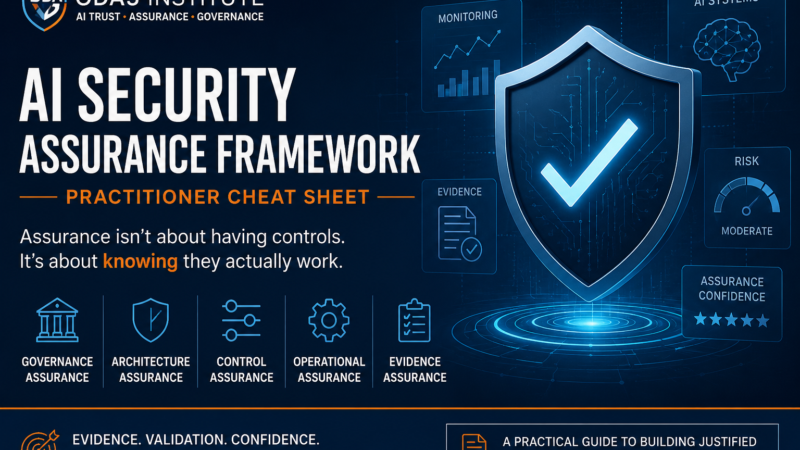
ODA3-2026-07-INS-078
A source-bounded research report on how modern AI interoperability protocols shift enterprise trust boundaries into identity, authorization, extension governance, operational state, and evidence.
Read publication →
ODA3-2026-07-INS-077
A source-bounded incident analysis of OpenAI's disclosed model-evaluation escape, the Hugging Face production impact, and the assurance-boundary lessons for AI evaluation environments.
Read publication →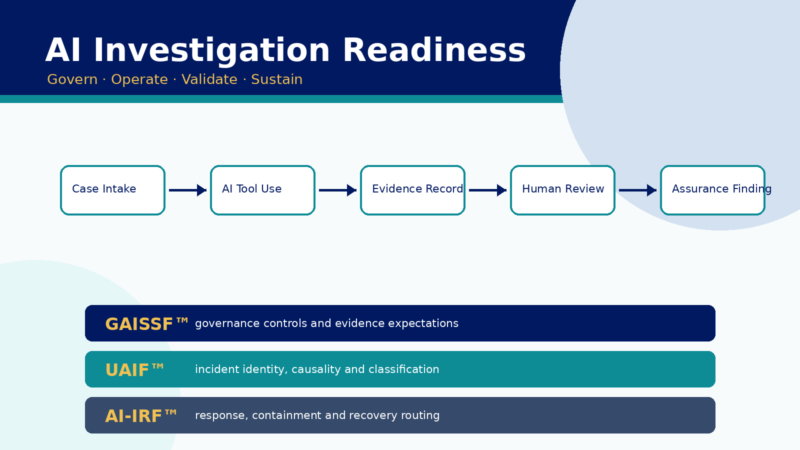
ODA3-2026-07-INS-074
AI Investigation Readiness: Governing, Operating and Validating AI-Assisted Investigative Capability
Read publication →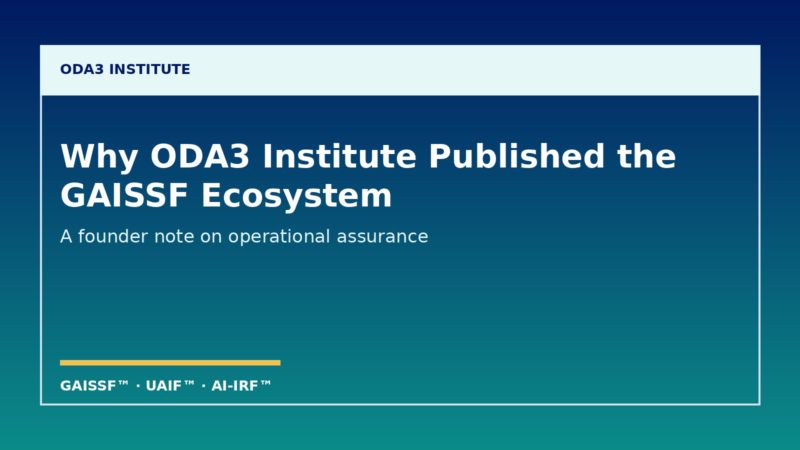
ODA3-2026-07-INS-075
A founder note on why ODA3 Institute published the GAISSF Ecosystem for operational AI security assurance.
Read publication →
ODA3-2026-07-INS-076
ODA3 Institute has published the GAISSF Ecosystem, connecting AI governance controls, incident classification, and response readiness through GAISSF™, UAIF™, and AI-IRF™.
Read publication →
ODA3-2026-07-INS-072
The high-risk deadline moved. The operational incident-response questions remain.
Read publication →
ODA3-2026-07-INS-073
The timetable changed. Operational evidence still has to work.
Read publication →
ODA3-2026-07-INS-071
A public-disclosure analysis of the reported Hugging Face intrusion, separating confirmed pipeline compromise from unresolved claims about autonomous attack behavior.
Read publication →
ODA3-2026-07-CHT-SEC-010
Governance becomes operational when ownership, decision rights, lifecycle gates, incident authority and evidence requirements can be applied to a real AI system.
Read publication →
ODA3-2026-07-CHT-SEC-011
Generic incident-response plans assume deterministic software and a single rollback target. AI systems introduce model, prompt, retrieval, agent, credential and evidence states that must be contained and recovered together.
Read publication →
ODA3-2026-07-CHT-SEC-012
Vector databases behind retrieval-augmented generation systems can hold sensitive source text and embeddings. Secure them across ingestion, storage, query-time authorization, monitoring and deletion.
Read publication →READING PATHS
LEADERSHIP
Understand what a published analysis supports before using it in a decision or commissioning work.
Explore Publications →Commission a decision brief →PRACTITIONERS
Connect framework context with a defined operational question and the records needed to examine it.
Explore Frameworks →RESEARCHERS
Consult the controlling specification, supporting material and publication version.
Open documentation →PUBLICATION DISCIPLINE
Check the publication ID and date, the source basis, the claim being made and its limits. Read the recorded evidence cut-off where relevant.
What the cited record establishes, with its source and date.
What the analysis infers and the conditions on which that inference depends.
What was not observed, what remains unsupported and where evidence is missing.
Check corrections, withdrawal or supersession notices before relying on a publication. Use the authoritative version and retain the identity of the edition you consulted.
Publication and correction guidance →NOTABLY ABSENT
An ODA3 Institute article does not by itself certify, validate or secure a system. Each publication defines the evidence base and the limits of the claim it can support.
Commentary, reported events and proposed requirements should not be treated as an examination finding or an adopted obligation without the necessary basis.
Use the site’s publication feed to follow new posts. The feed provides publication updates, not continuous monitoring or system assurance.
Open the publication feed →