
An organization may have an approved AI governance policy, a comprehensive system inventory, documented security controls and completed audit checklists. But what can those records actually prove?
Do they establish that a security control was deployed? That an authorization decision was enforced? That an AI agent operated within its delegated authority? Or merely that the organization documented its intentions?
These distinctions are central to evidence-based AI security assurance.
On 4 November 2026, the Indian Computer Emergency Response Team (CERT-In) published its Artificial Intelligence (AI) Security Auditing Guidelines, providing a structured reference for AI security governance, risk-tier assessment, technical testing and audit practices. For practitioners, understanding the source framework is only part of the challenge: can the available evidence substantiate the claim being examined?
ODA3 Institute’s new independent practitioner guide addresses that examination question.
Introducing the Evidence Readiness and Examination Matrix
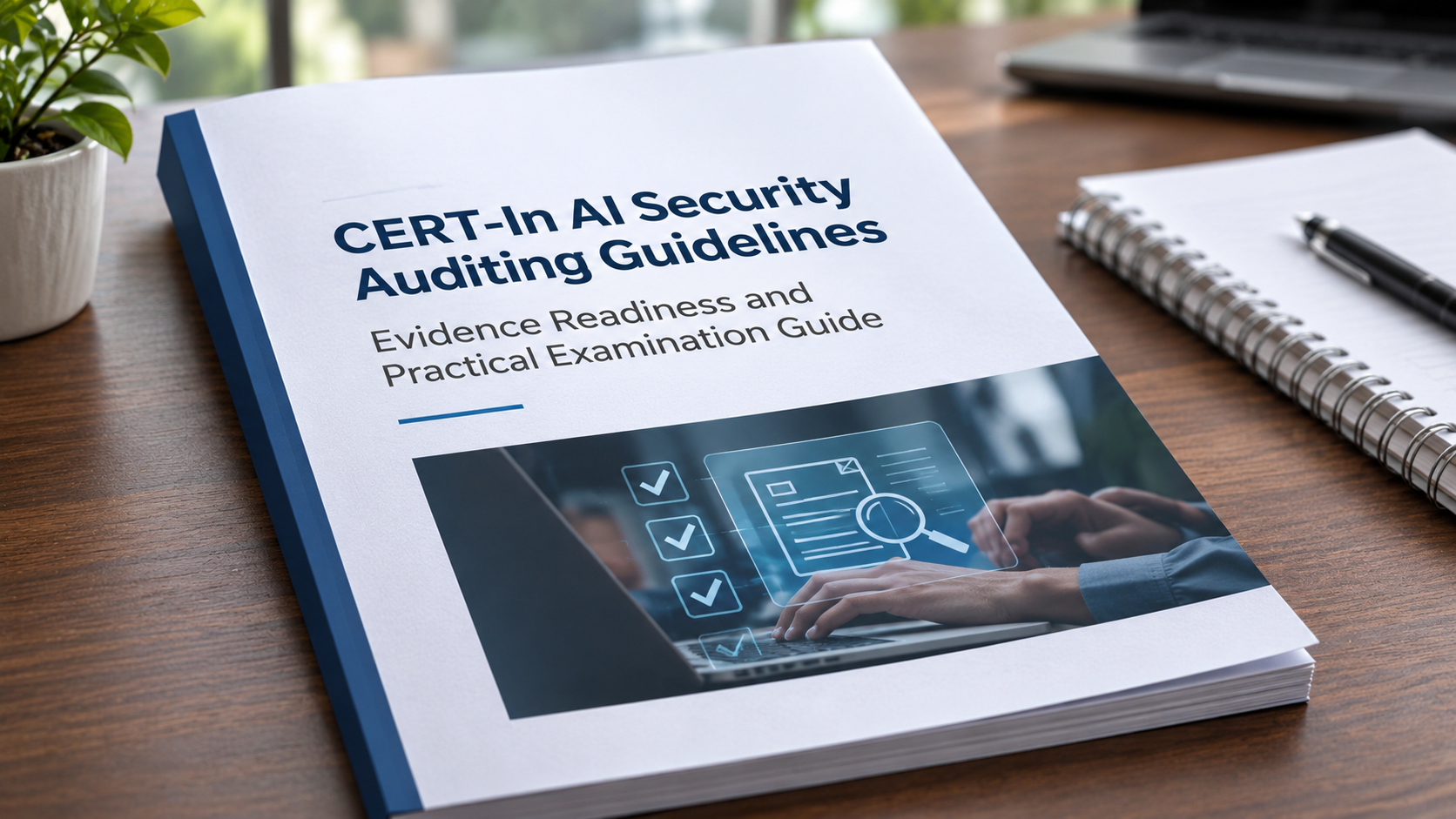
CERT-In AI Security Auditing Guidelines: Evidence Readiness and Examination Matrix
An Independent Practitioner Guide to Source Traceability, Audit Evidence and Examination Limitations
Edition 1 · Version 1.0 · 24 November 2026 · 28 pages
The guide presents 41 selected evidence-readiness examinations, alongside nine audit-domain overviews, candidate evidence and explicit limits on the conclusions those records can support. It does not reproduce the CERT-In Guidelines as a checklist or prescribe evidence requirements on behalf of the regulator.
From documented approval to demonstrable enforcement
Consider an AI agent authorized to execute transactions subject to human approval. An organization may maintain a policy requiring approval before a consequential transaction proceeds. That policy establishes an intended control; it does not demonstrate enforcement.
A meaningful examination asks:
- Which policy and configuration versions governed the transaction?
- Was the approval requirement implemented in the relevant execution path?
- Who held authority to approve the action?
- What approval or denial decision was recorded?
- What did the downstream execution system actually do?
- Can the transaction be reconstructed from attributable, time-bounded records?
A policy is not an operating outcome. An approval record does not necessarily establish what downstream services executed. A gateway denial does not show that every alternative path was blocked. Each record must be assessed against the particular proposition it can support.
What the guide examines
The publication distinguishes six evidence classes: documented design; implementation; operating outcome; negative observation; third-party representation; and simulation or rehearsal. It also uses eight evidence-result states to preserve distinctions among what was observed, contradicted, inaccessible or unresolved. Those states describe examination outcomes; they are not regulatory conformity grades.
The guide addresses four CERT-In system-risk tiers, taking care not to confuse conditional enhanced audit frequency with an unconditional timetable. Practitioners should consult the underlying source tables and their qualifications rather than relying on a compressed tier summary.
Nine source audit-domain overviews address:
- AI Governance & Accountability;
- Data Lifecycle, Quality & Privacy;
- Model Risk Management (MRM);
- AI Ethics, Bias & Fairness;
- Explainability & Transparency;
- Security, Adversarial Resilience & Incident Reporting;
- Continuous Monitoring, Drift Management & Validation;
- Human Oversight & Decision Accountability; and
- Third-Party and AI Supply-Chain Assurance.
Selected examinations also consider agentic and multi-agent systems, retrieval-augmented generation, model supply chains, human intervention, incident reconstruction and the distinction between control-command acknowledgement and observed effects in cyber-physical settings.
The guide maintains a separation between the April 2022 CERT-In Directions and the November 2026 AI Security Auditing Guidelines. It does not assume every AI malfunction, hallucination or model-drift signal is automatically a six-hour reportable cybersecurity incident.
Coverage is selective. It is not a line-by-line treatment of every provision in the Guidelines.
Why this matters
For CISOs, security architects, AI governance leads, compliance professionals and auditors, the operational challenge is not simply collecting more evidence. It is deciding whether records are relevant, attributable, sufficiently complete and appropriate to the claim under examination.
A model inventory does not prove deployment completeness. A supplier attestation does not demonstrate customer-side operation. A successful test does not establish sustained effectiveness across every later configuration. An inaccessible record does not, by itself, prove a control failed.
A responsible examination preserves these boundaries rather than turning missing information into reassuring conclusions.
Download the practitioner guide
CERT-In AI Security Auditing Guidelines: Evidence Readiness and Examination Matrix
ODA3 Institute · Edition 1 · Version 1.0 · PDF · 28 pages
Download the practitioner guide (PDF)
Free public download; no registration required. Readers should consult the original CERT-In Guidelines alongside this independent research publication.
Publication information and citation
Publisher: ODA3 Institute
Publication ID: ODA3-2026-11-RG-001
Publication date: 24 November 2026
Version: Edition 1, v1.0
PDF length: 28 pages
SHA-256 (publication PDF): a50110894175556048c7cbcceda5524951c00796bee697a694959b7ec4b98dd3
Suggested citation: ODA3 Institute. (2026). CERT-In AI Security Auditing Guidelines: Evidence Readiness and Examination Matrix (Edition 1, Version 1.0; ODA3-2026-11-RG-001). ODA3 Institute.
A revised file must receive a new version identifier and checksum; the publication ID remains stable. Corrections and replacements should be logged on this page.
Independence and limitations
This publication is independent practitioner research by ODA3 Institute and is not issued, approved, certified or endorsed by CERT-In. The technical review was founder-led; no separate external independent technical review is claimed. Examination questions, candidate evidence and limitations are ODA3 Institute interpretations, not regulator-prescribed evidence requirements. This is not an authorised audit, legal opinion, conformity determination or certification.
Notably Absent
No real AI system, production environment, customer incident or assessment client was examined for this guide. No organization-specific operating-effectiveness, regulatory conformity, legal-applicability or functional-safety determination is claimed. No complete coverage of the underlying Guidelines is asserted.
The publication’s purpose is to make security evidence claims more examinable—and to make the boundaries of what remains unverified visible.
ODA3 Institute — Where AI governance meets operational reality.
Methodology note
Nine source audit-domain overviews; 41 selectively chosen examination records; six evidence classes; eight result states; distinguish design, implementation, outcomes, negative observations, third-party representations and simulation.
Notably Absent
No examined production AI system, client, incident or assessment; no operating effectiveness, regulatory conformity, legal applicability or functional safety conclusion; no full line-level coverage; no external independent review, CERT-In endorsement, certification or statutory audit.