
ODA3-2026-07-INS-075
Why ODA3 Institute Published the GAISSF Ecosystem
A founder note on why ODA3 Institute published the GAISSF Ecosystem for operational AI security assurance.
Read publication →PUBLICATION COLLECTION
Browse this collection and consult each publication for its evidence, sources and stated limitations.
ODA3-2026-07-INS-075
A founder note on why ODA3 Institute published the GAISSF Ecosystem for operational AI security assurance.
Read publication →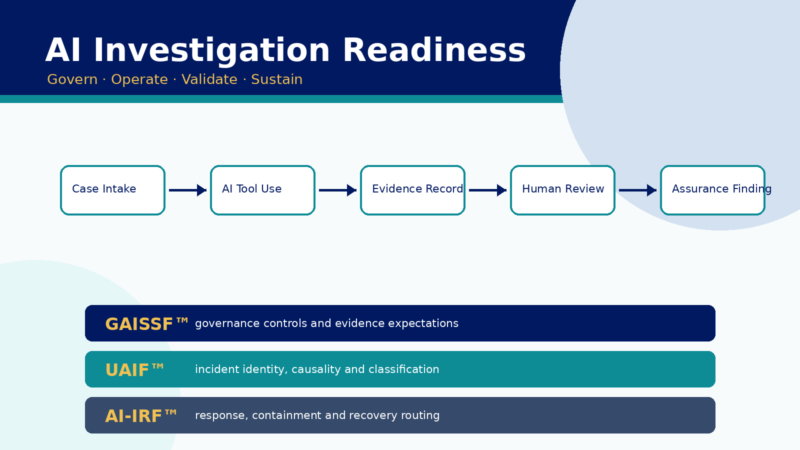
ODA3-2026-07-INS-074
AI Investigation Readiness: Governing, Operating and Validating AI-Assisted Investigative Capability
Read publication →
ODA3-2026-07-INS-073
The timetable changed. Operational evidence still has to work.
Read publication →
ODA3-2026-07-INS-072
The high-risk deadline moved. The operational incident-response questions remain.
Read publication →
ODA3-2026-07-INS-071
A public-disclosure analysis of the reported Hugging Face intrusion, separating confirmed pipeline compromise from unresolved claims about autonomous attack behavior.
Read publication →
ODA3-2026-07-CHT-SEC-013
Retrieval-augmented generation creates a security boundary across sources, ingestion, retrieval, context, generation and downstream action. Protecting only the model or vector database leaves the rest of that boundary exposed.
Read publication →
ODA3-2026-07-CHT-SEC-012
Vector databases behind retrieval-augmented generation systems can hold sensitive source text and embeddings. Secure them across ingestion, storage, query-time authorization, monitoring and deletion.
Read publication →
ODA3-2026-07-CHT-SEC-011
Generic incident-response plans assume deterministic software and a single rollback target. AI systems introduce model, prompt, retrieval, agent, credential and evidence states that must be contained and recovered together.
Read publication →
ODA3-2026-07-CHT-SEC-010
Governance becomes operational when ownership, decision rights, lifecycle gates, incident authority and evidence requirements can be applied to a real AI system.
Read publication →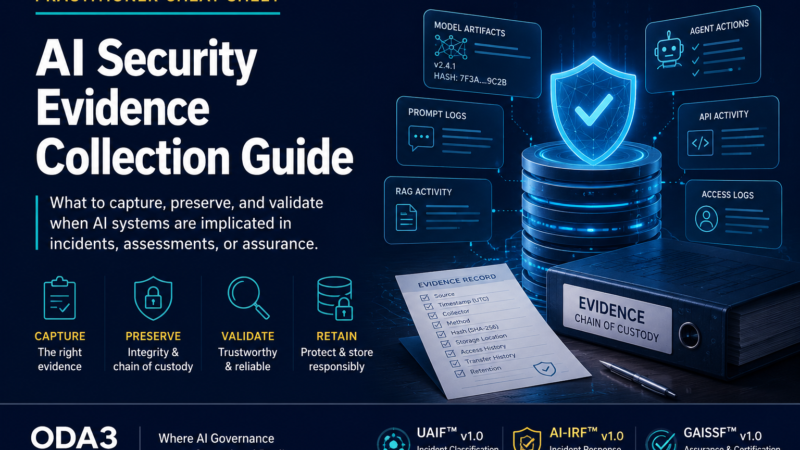
ODA3-2026-07-CHT-SEC-009
Most organizations discover their AI evidence gaps mid-incident, mid-audit, or mid-assessment—when it is too late to recover what was never logged.
Read publication →