ODA3-2026-08-INS-080 · Published 3 August 2026
We Secured How AI Thinks. Now We Have to Secure How AI Moves.
Why PAI-SF™ introduces a distinct assurance architecture for the point where AI decisions become physical actions.
Executive overview
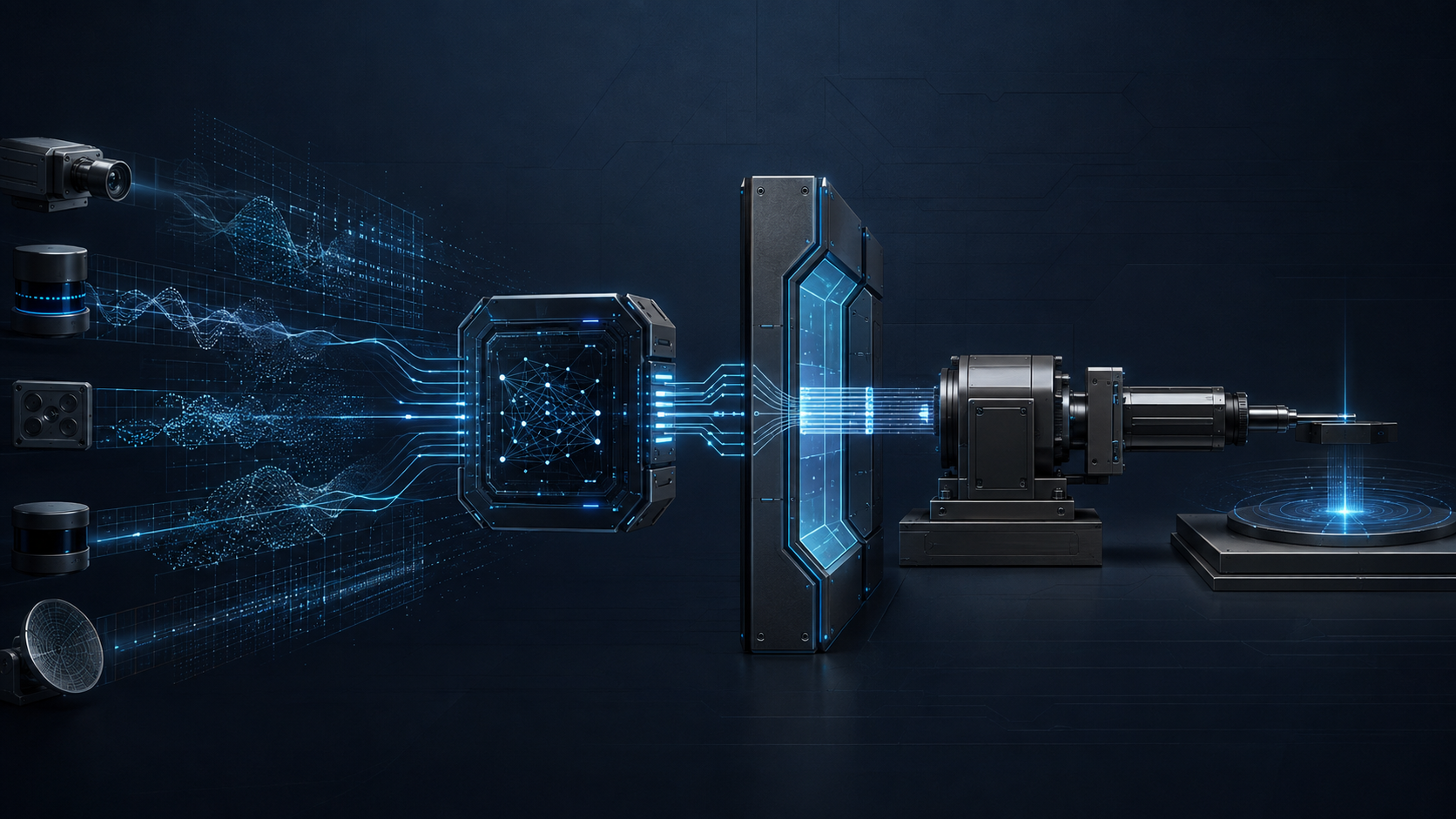
PAI-SF™ v1.0 is ODA3 Institute’s Physical AI Security Framework for systems whose AI decisions can create direct physical effects. The publication explains why model, data and application controls are necessary but incomplete when AI can steer, lift, dispense, stop or otherwise alter physical state. It defines the assurance object as a continuous pathway from perception and model decision through autonomy boundaries, kinetic command, physical effect, monitoring, intervention and recovery.
The framework contains 12 domains and 41 controls. Its central operating concept, Kinetic Zero Trust, rejects the assumption that an authorized or high-confidence model should automatically be trusted to execute a physical command. The publication places PAI-SF™ alongside GAISSF™, UAIF™ and AI-IRF™ as a complementary physical-assurance layer, and explains its interface with AI governance, AI security, industrial security and functional-safety disciplines.
The analysis is deliberately bounded. PAI-SF™ is not a functional-safety certification, conformity route, product approval or regulatory requirement. No independent efficacy studies, broad operational adoption, published certification mechanics, validated retrofit-cost model or regulatory recognition exist at release. The publication therefore presents PAI-SF™ as a candidate architecture at day one: its value must ultimately be established through pilots, independent scrutiny, assessor calibration and evidence from real deployments.
Key takeaways
- PAI-SF™ treats the perception-to-physical-effect pathway as one assurance object.
- The framework contains 12 domains and 41 public controls.
- Kinetic Zero Trust separates authority to decide from authority to act physically.
- PAI-SF™ interfaces with functional safety; it does not replace safety certification.
- No adoption, efficacy, certification-mechanics or regulatory-recognition claim is made.
Who should read this
Why it matters now
Physical AI extends assurance beyond model output into sensors, autonomy, commands, actuators, intervention and recovery. PAI-SF™ v1.0 provides a public architecture for examining that longer chain while explicitly documenting the evidence that does not yet exist.
Full publication
We Secured How AI Thinks. Now We Have to Secure How AI Moves.
Why PAI-SF™ introduces a distinct assurance architecture for the point where AI decisions become physical actions
Doc ID: ODA3-2026-08-INS-080 Doc Type: Insight Framework tag: PAI-SF™ (GAISSF Ecosystem) Audience: CISOs, Security Architects, AI Governance Leads, Compliance Officers, Standards Body Participants Publish date: 3 August 2026 | Review cycle: Quarterly
Methodology Note. This Insight analyzes the structural release of PAI-SF™ v1.0, based on the published framework documentation (12 domains, 41 controls) and its stated crosswalks. Because the framework was published today, no independent implementation studies, incident-reduction data, or assessor-consistency results exist yet. Claims about global impact concern the framework's structural potential and the assurance gap it addresses — not demonstrated adoption or measured effectiveness. Comparisons to other named standards below are editorial, for scope explanation, and should not be read as formal crosswalk or equivalence claims unless expressly documented in the published PAI-SF™ standards crosswalk.
PAI-SF™ is not a functional-safety certification, regulatory conformity route, or product approval. It is a physical-AI security assurance framework designed to interface with those existing disciplines, not replace them.
The question mainstream AI assurance frameworks were not designed to answer
AI security has developed rapidly around models, data, and applications — adversarial manipulation, data poisoning, prompt injection, insecure outputs, compromised dependencies, unauthorized access. AI governance has added inventories, accountability, oversight, and regulatory mapping on top.
Functional-safety, product-safety, and industrial-security disciplines have separately governed machines, vehicles, and control systems for decades — they are not new to physical effect.
What's been missing is the seam between them: mainstream AI governance and AI security frameworks were generally not designed to treat the entire perception-to-physical-effect pathway as a single, unified assurance object. When an AI-generated decision becomes a command to steer, lift, dispense, or stop, the question stops being "is the model or pipeline secure?" and becomes:
Is the complete pathway from perception to physical effect controlled, observable, interruptible, and recoverable?
That pathway is the kinetic gap — and it's what PAI-SF™ v1.0 was built to address.
ODA3 Institute has published PAI-SF™ v1.0 — the Physical AI Security Framework — live at docs.oda3.org/frameworks/pai-sf, dated 3 August 2026. 12 domains. 41 controls. Practitioner-first. Public. No certification or compliance claim attached.
For AI systems whose effects remain primarily informational, existing AI governance and security frameworks may already cover much of the relevant assurance boundary. Where AI can move, lift, drive, cut, dispense, steer, or otherwise alter physical state, an additional physical-assurance layer becomes necessary — and that scope distinction matters: not every AI-connected physical device creates the same assurance boundary as a system where AI meaningfully drives perception, decision, autonomy, and physical execution together.
A longer, more consequential assurance chain
For software-based AI, the assurance chain most frameworks assume is roughly: data → training → model → deployment → output → monitoring.
Physical AI runs a longer pathway, and PAI-SF makes every stage of it a distinct assurance question:
perception → model decision → autonomy boundary → kinetic command → physical effect → monitoring → intervention → recovery
Can the system trust what it senses? Is the deployed model the approved one? Is a technically valid command still physically unsafe? Is the actuator constrained independently of the model's own confidence? Can a person intervene fast enough? What happens when confidence falls or connectivity drops? Can investigators reconstruct the sequence afterward? Can the system be safely recovered and returned to service?
A model can be authenticated, access-controlled, and correctly deployed while still producing an unsafe physical action. Physical-AI assurance has to examine the whole chain, not just the model at the front of it.
Where PAI-SF sits in the ODA3 ecosystem
| Framework | Layer | What it answers |
|---|---|---|
| GAISSF™ | Governance across the full lifecycle | What are the control objectives, ownership, and evidence expectations spanning deployment, runtime, incident, and supply-chain conditions? |
| UAIF™ | Classification | When an anomaly occurs, what is its severity, impact, and confidence — in language security and safety teams share? |
| AI-IRF™ | Response | Once classified, how is triage, containment, recovery, and notification coordinated? |
| PAI-SF™ | Physical assurance | How is the system built so perception, autonomy, and kinetic command are trustworthy before any of the above is needed? |
AI-IRF gives you the playbook for reacting once an autonomous vehicle has already swerved into the wrong lane. PAI-SF defines the sensor integrity, edge attestation, and human-override mechanisms bearing on whether that swerve was preventable. Together they form one lifecycle — govern → secure → test → monitor → detect → classify → respond → recover → revalidate — not four competing frameworks.
The 12 domains, at a glance
Sensing & decision: D1 Sensor & Perception Integrity · D2 Actuator & Kinetic Command Safety · D3 Edge Hardware & Model Attestation Boundaries & behavior: D4 Autonomy Boundaries · D5 Safe-State & Degraded-Mode Behavior · D6 Human Override & Intervention Visibility & response: D7 Runtime Monitoring & Telemetry · D8 Incident Response & Physical Recovery · D9 Supply Chain & Update Assurance Validation & context: D10 Simulation, Testing & Validation · D11 Functional Safety Interface · D12 Physical Operating Environment
41 controls sit across these 12 domains. No scoring thresholds or certification-decision rules are published for v1.0.
Kinetic Zero Trust
The concept most likely to outlast the full control catalogue.
Enterprise Zero Trust rejected an old assumption: don't trust an identity or device just because it's inside the network perimeter. Kinetic Zero Trust applies the same logic to physical action: don't trust a command just because it came from an authorized, high-confidence model.
A correctly authenticated model can still be wrong, compromised, overconfident, operating outside its design domain, deceived by its own sensors, or simply issuing an unsafe command. Before a command capable of physical effect executes, PAI-SF requires it be checked — independently of the model's own authorization — against operating limits, sensor confidence, environmental state, human-presence conditions, and safety interlocks.
The separation this creates: authority to generate a decision is not automatically authority to produce a physical effect.
How PAI-SF differs from adjacent assurance disciplines
- AI governance frameworks (GAISSF™, NIST AI RMF, ISO/IEC 42001) establish accountability, ownership, and risk policy. PAI-SF™ translates those expectations into engineering-level questions — autonomy limits, degraded-mode behavior, intervention authority, safe-state transitions, and command constraints — rather than policy statements.
- AI security frameworks (e.g., OWASP LLM Top 10) address how models and pipelines get attacked. PAI-SF's Domains 1–2 (Sensor & Perception Integrity, Actuator & Kinetic Command Safety) address how those same attack patterns — spoofed input, manipulated confidence, injected commands — propagate into physical movement.
- Functional-safety standards (e.g., IEC 61508, ISO 26262) address hazards arising from malfunctioning behavior and the performance of safety-related systems — a different problem than adversarial manipulation. PAI-SF's Domain 11 (Functional Safety Interface) addresses the security conditions that can undermine a safety case's assumptions: manipulated perception, unauthorized firmware or model change, autonomy escalation, and compromised command pathways. It does not replace safety certification or determine safety-rated mechanism design.
Three structural contributions worth naming specifically:
A defined functional-safety interface. Security and safety teams have historically used different risk models with the handoff between them left informal. PAI-SF makes it explicit — which team owns perception integrity and command authorization, which owns safety-rated stops, and what happens when a security condition undermines a safety assumption.
Autonomy and intervention treated as testable, not just declared. PAI-SF treats autonomy as a bounded, testable property — what a system may decide, where it may operate, whether its authority can expand — rather than a feature description. Human override gets the same treatment: not whether an emergency stop exists on paper, but whether it stays usable and fast enough under realistic failure conditions.
Supply-chain assurance extended to the edge. Physical AI typically runs on distributed edge devices with intermittent connectivity and long maintenance cycles. PAI-SF extends supply-chain assurance to the integrity and provenance of deployed models, edge compute, firmware, and replacement hardware — not just software dependencies.
What this could change for four groups
- Suppliers and manufacturers could move toward evidencing sensor integrity, model authenticity, firmware provenance, autonomy limits, and override capability — control language that could be adapted for supplier questionnaires, RFPs, technical due diligence, and underwriting reviews, rather than general best-practice claims.
- AI governance and assurance platforms built around inventories, policies, and model cards would need to represent sensors, actuators, edge hardware, autonomy levels, and physical intervention mechanisms to cover this category.
- Insurers and investors underwriting or funding autonomous fleets and industrial robotics gain a defined set of control areas to request evidence against — though no insurer or investor adoption of PAI-SF specifically has been established.
- Incident investigators gain a structure for reconstructing sensor state, autonomy mode, issued commands, and recovery actions, connecting to UAIF™ and AI-IRF™ for classification and response.
Physical-AI deployment is expanding from controlled pilots into operational environments across logistics, manufacturing, mobility, healthcare, and infrastructure, though adoption maturity varies substantially by sector and jurisdiction. Regulatory instruments such as the EU AI Act treat certain physical-effect systems as high-risk depending on the applicable provisions and system category — not as a blanket classification. Procurement may move faster than formal regulatory recognition, since buyers and insurers can introduce evidence requirements without waiting for a framework to gain legal standing — but this is a plausible direction, not an established trend.
Evidence & Analytical Status Ledger
| Claim | Evidence Confidence | Analytical Status |
|---|---|---|
| PAI-SF™ v1.0 is published with 12 domains / 41 controls, effective 3 August 2026 | T1 | Verified Fact |
| Mainstream AI governance and AI security frameworks generally do not treat the perception-to-physical-effect chain as a unified assurance object | T3 | Analytical Assessment |
| Kinetic Zero Trust represents a materially different assurance posture than model-output-focused AI security approaches | T3 | Analytical Assessment |
| Procurement, insurance, or platform vendors will reference PAI-SF-style control language within the next 12 months | N/A | Forward-looking Hypothesis |
| PAI-SF will be adopted by assessors, cited by regulators, or built against by sector integrators at scale | N/A | Forward-looking Hypothesis |
| PAI-SF marks a permanent, industry-wide inflection point in physical-AI security practice | N/A | Unknown |
Notably Absent
- Independent efficacy evidence. No longitudinal dataset yet shows that implementing the 41 controls reduces physical-AI incident frequency, severity, or recovery time in live production environments.
- Broad operational adoption. No claim is made that PAI-SF has achieved adoption by manufacturers, operators, regulators, insurers, or standards bodies — publication is not adoption.
- Published certification mechanics. No pass/fail thresholds, weighting model, assessor-calibration procedure, or certification-decision rule is published — deliberate within the current public framework boundary, not necessarily an oversight.
- Cost and implementation modeling. No validated model exists for the cost of retrofitting existing robotics, AV, or industrial fleets to the 41 controls.
- Regulatory recognition. PAI-SF is not a regulatory requirement, recognized conformity route, or product-safety approval, and does not replace functional-safety, aviation, medical-device, automotive, machinery, or workplace-safety obligations — it interfaces with them.
- Empirical validation data. No proprietary incident dataset is published as empirical validation for PAI-SF™ v1.0.
The honest version of "new era"
"New era" earns its place here only if the underlying assurance boundary has genuinely moved — not merely because a framework was published today.
The first phase of AI assurance concentrated on model quality, fairness, and governance. The next phase added adversarial robustness, model security, and incident response. Physical AI introduces a further shift: AI systems that navigate environments, manipulate objects, and operate near people can no longer have their assurance stop at model output. It has to continue until the physical effect itself has been constrained, observed, and — where necessary — interrupted or recovered.
That's the real shift: from model assurance to effect assurance. PAI-SF is a candidate architecture for it, not a finished one. What happens next — independent review, real pilots, sector-specific profiles, assessor calibration, evidence from actual deployments — will decide whether it becomes the reference point the discipline converges on. This Insight marks day one of that process, not its outcome.
PAI-SF™, GAISSF™, UAIF™, and AI-IRF™ are ODA3 Institute frameworks. Use of their protected materials is governed by the applicable terms of the GAISSF Ecosystem License (GEL) v1.0.
© 2026 ODA3 Pvt Ltd. Published by ODA3 Institute.