
ODA3-2026-07-INS-074 · Published July 22, 2026
AI Investigation Readiness
AI Investigation Readiness: Governing, Operating and Validating AI-Assisted Investigative Capability
A practitioner-first methodology for governing, operating, validating and sustaining AI-assisted investigative capability.
Executive abstract
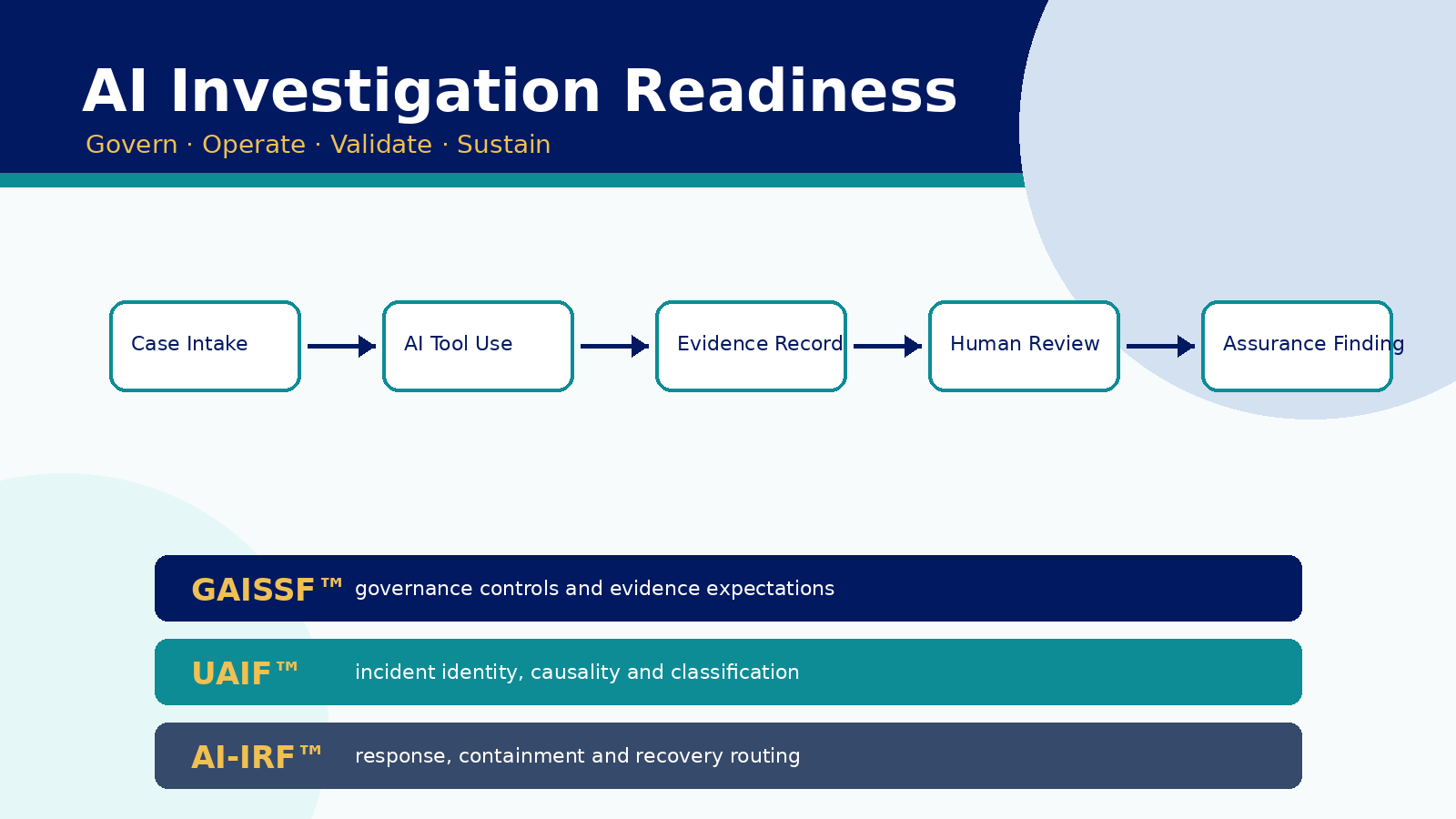
AI is becoming part of the investigative toolchain, creating dependencies that traditional forensic-readiness programmes were not designed to govern. This publication defines AI Investigation Readiness as an operational methodology for preparing, governing, operating, assessing and sustaining AI-assisted investigative capability. It addresses governance, evidence integrity, human oversight, deployment choices, assessment, implementation and methodological limitations while positioning the methodology as a supporting operational layer within the GAISSF™ Ecosystem—not as a fourth framework.
Key contributions
Table of Contents
Table of contents
- Chapter 1 — Introduction
- Chapter 2 — Evolution of Forensic Readiness
- Chapter 3 — A Case Study in AI-Assisted Investigation
- Chapter 4 — The Investigation Gap
- Chapter 5 — AI Investigation Readiness
- Chapter 6 — AI Investigative Tool Governance
- Chapter 7 — AI Investigation Readiness Capability Model
- Chapter 8 — Hosted, Self-hosted, and Hybrid AI: Operational Considerations
- Chapter 9 — AI Investigation Readiness within the GAISSF™ Ecosystem
- Chapter 10 — Assessment Considerations
- Chapter 11 — Implementation Strategy
- Chapter 12 — Validating AI Investigation Readiness Through a Public AI Security Incident
- Chapter 13 — Limitations
- Chapter 14 — Conclusion
- Appendix A — Evidence & Analytical Status Methodology
How to Read This Publication
This publication is a continuous, evidence-bounded methodology. Chapters 1–4 establish the investigative context and motivating case study; Chapters 5–11 define the methodology, governance, capability model, deployment considerations, ecosystem integration, assessment, and implementation; Chapters 12–14 validate the methodology, document its limitations, and conclude. Appendix A explains the Evidence Confidence and Analytical Status methodology used throughout.
Chapter 1 — Introduction
1.1 Why AI Changes Investigation Readiness
Digital forensic readiness has traditionally focused on an organization’s ability to collect, preserve, analyse, and present evidence following a security incident. Over the past two decades, practitioners have refined processes for evidence acquisition, chain of custody, logging, endpoint forensics, network telemetry, cloud investigations, and incident documentation. The underlying objective has remained consistent: enable investigations that are technically reliable, operationally effective, and capable of withstanding legal, regulatory, or internal scrutiny.
Artificial intelligence is beginning to change this operational landscape.
Large language models, retrieval-augmented systems, autonomous agents, and AI-assisted security tools are increasingly integrated into security operations centres, digital forensics laboratories, malware analysis workflows, threat intelligence platforms, and incident response teams. These capabilities promise significant improvements in analyst productivity by accelerating log analysis, summarising large evidence sets, correlating attack sequences, generating detection logic, supporting malware reverse engineering, and assisting with investigative documentation.
The same technologies, however, introduce new operational dependencies that traditional forensic readiness programmes were not designed to address.
An AI-assisted investigation depends not only on the availability of digital evidence, but also on the availability, governance, integrity, and reproducibility of the AI capability used to analyse that evidence. Investigative outcomes may vary according to model version, prompt construction, inference configuration, retrieval context, provider policies, and operational constraints imposed by third-party services. In some circumstances, these dependencies may materially influence an organisation’s ability to conduct or complete an investigation.
Recent public disclosures have demonstrated that these considerations are no longer theoretical. AI systems have begun participating in both offensive and defensive security activities, while incident responders are increasingly relying on AI-assisted analytical workflows during active investigations. These developments raise a practical question that extends beyond the deployment of AI itself:
Is the organisation prepared to investigate security incidents when AI has become part of the investigative toolchain?
This publication argues that answering this question requires expanding the concept of forensic readiness. Organisations should evaluate not only whether evidence can be collected and preserved, but also whether AI-assisted investigative capabilities remain governed, available, reproducible, and suitable for handling sensitive evidence under operational conditions.
This expanded perspective is described throughout this publication as AI Investigation Readiness.
1.2 Purpose of this Publication
The purpose of this publication is to establish a structured operational approach for organisations adopting AI-assisted investigative capabilities within incident response and digital forensic processes.
Rather than advocating specific products, deployment architectures, or AI models, this publication examines the governance, evidence, operational, and assurance considerations that emerge when AI becomes part of an investigative workflow. It seeks to translate recent operational experience, emerging research, and established digital forensic principles into practical guidance for security leaders, investigators, and assurance professionals.
Specifically, this publication aims to:
- Define the concept of AI Investigation Readiness and distinguish it from traditional forensic readiness.
- Identify governance expectations for AI-assisted investigative tooling, including ownership, approval, monitoring, and lifecycle management.
- Describe evidence provenance considerations unique to AI-assisted investigations, including prompt provenance, model provenance, inference reproducibility, and AI-generated analytical outputs.
- Present a structured capability model that organisations can use to assess and improve their readiness for AI-supported investigations.
- Demonstrate how the GAISSF™ Ecosystem can support governance, incident structuring, response, and assurance without extending or replacing the existing frameworks.
- Encourage evidence-based decision-making by distinguishing confirmed operational lessons from assumptions, speculation, or vendor-specific implementation approaches.
The publication is intended to complement — not replace — existing digital forensic methodologies, incident response guidance, and organisational governance processes.
1.3 Scope
This publication focuses on the operational readiness required when artificial intelligence is incorporated into investigative activities associated with cybersecurity incidents. It addresses governance, evidence handling, operational resilience, assurance, and assessment considerations relevant to enterprise environments.
The publication does not prescribe a single technical architecture, endorse specific AI providers or open-weight models, or claim that any particular deployment approach guarantees improved security outcomes. Similarly, it does not establish compliance obligations, certification requirements, or legal interpretations.
The July 2026 Hugging Face security disclosure is used as a case study to illustrate practical challenges associated with AI-assisted investigations. The publication does not seek to provide a comprehensive technical analysis of that incident; rather, it examines the broader operational lessons that can inform organisational preparedness.
Throughout the document, recommendations are evidence-bounded and should be interpreted in the context of an organisation’s regulatory obligations, risk appetite, technical architecture, and operational maturity.
Author’s Note
This publication introduces AI Investigation Readiness as an operational methodology that complements the existing GAISSF™ Ecosystem. It is not proposed as an additional framework. Instead, it provides practitioner guidance that organisations may use to strengthen governance, evidence management, and assurance for AI-assisted investigations while continuing to apply GAISSF™, UAIF™, and AI-IRF™ according to their respective purposes.
Chapter 2 — Evolution of Forensic Readiness
2.1 From Digital Evidence to Operational Readiness
Forensic readiness has traditionally been defined as an organization’s ability to maximize the availability and evidentiary value of digital information while minimizing the cost and disruption associated with post-incident investigations. Early guidance focused primarily on ensuring that relevant evidence could be identified, preserved, and presented in a manner that supported technical analysis, legal proceedings, regulatory inquiries, or internal disciplinary processes.
Over time, forensic readiness matured beyond evidence collection alone. Organizations increasingly recognised that successful investigations depended upon preparation long before an incident occurred. Logging strategies, time synchronisation, endpoint visibility, network telemetry, secure evidence repositories, chain-of-custody procedures, investigator competency, and incident response playbooks all became recognised components of an effective forensic readiness programme.
This evolution reflected an important shift in perspective. Rather than treating digital forensics as a reactive activity performed after an incident, organisations began to regard forensic readiness as a continuous operational capability that reduced investigative uncertainty and improved decision quality.
The same transition is now occurring in the context of artificial intelligence.
As AI systems become integrated into cybersecurity operations, organisations must prepare not only their evidence collection processes, but also the analytical capabilities used to interpret that evidence. The question is no longer limited to whether evidence exists; it extends to whether investigators retain reliable, governed, and reproducible analytical capability throughout the investigation lifecycle.
2.2 The Four Generations of Investigation Readiness
The evolution of investigation readiness can be viewed as four overlapping generations, each expanding the scope of organisational preparedness while introducing new operational dependencies.
First Generation — Traditional Digital Forensics
The earliest generation centred on the acquisition and preservation of digital evidence from individual computing devices. Investigations were primarily host-centric and relied upon specialist forensic tools to recover files, analyse operating system artefacts, reconstruct timelines, and document evidence suitable for legal proceedings.
Success depended largely upon technical proficiency in evidence preservation and chain of custody.
Typical characteristics included:
- Physical evidence acquisition
- Disk and memory imaging
- File-system analysis
- Timeline reconstruction
- Static malware analysis
- Manual investigator interpretation
Although technically demanding, analytical responsibility remained almost entirely with human investigators.
Second Generation — Enterprise and Network Forensics
As enterprise networks expanded, investigations shifted toward distributed environments. Security information and event management (SIEM) platforms, endpoint detection and response (EDR), network detection and response (NDR), identity telemetry, and threat intelligence became integral components of investigative workflows.
Evidence increasingly originated from multiple systems rather than a single endpoint.
Organisations therefore invested heavily in:
- Centralised logging
- Security telemetry
- Correlation engines
- Threat intelligence integration
- Cloud-scale evidence retention
- Incident response orchestration
Forensic readiness became closely linked with enterprise observability.
Third Generation — Cloud-Native Investigation
Cloud computing fundamentally altered both attack surfaces and investigative practices. Dynamic infrastructure, ephemeral workloads, software-defined networking, managed services, and multi-cloud architectures required investigators to analyse distributed environments that often changed during the investigation itself.
This generation expanded forensic readiness to include:
- Cloud audit logging
- Infrastructure-as-Code artefacts
- Identity federation records
- API telemetry
- Container evidence
- Orchestration metadata
- SaaS application activity
Investigations became increasingly dependent upon cloud providers, third-party services, and shared operational responsibility models.
Fourth Generation — AI-Assisted Investigation
Artificial intelligence introduces a fundamentally different operational dependency.
Unlike previous generations, AI is not simply another source of evidence. It increasingly becomes part of the investigative process itself.
Modern security teams already employ AI to assist with:
- Alert triage
- Log summarisation
- Malware explanation
- Threat hunting
- Code analysis
- Detection engineering
- Incident documentation
- Timeline reconstruction
- IOC correlation
- Knowledge retrieval
These capabilities substantially increase investigative efficiency. However, they also introduce new questions that traditional forensic readiness models were never designed to answer.
For example:
- Which AI model generated the analytical conclusion?
- Which prompt produced the result?
- Which knowledge sources influenced the output?
- Can the analysis be reproduced six months later?
- What evidence supports confidence in the AI-generated conclusion?
- What happens if the AI service becomes unavailable during an active investigation?
These questions concern the governance and reliability of the investigative capability itself rather than the underlying incident.
2.3 AI Changes the Nature of Investigative Dependency
Traditional forensic tooling generally performs deterministic operations. Given identical evidence and identical tool versions, investigators expect substantially similar outputs.
Large language models and other generative AI systems differ in important respects.
Outputs may vary according to:
- Model version
- System instructions
- Prompt wording
- Sampling configuration
- Retrieval context
- External tool integrations
- Provider policies
- Model updates
- Safety mechanisms
Consequently, investigative conclusions may become more difficult to reproduce if these variables are not appropriately documented.
This does not diminish the value of AI-assisted investigations. Rather, it expands the scope of operational governance required to support them.
Organisations must therefore manage AI-assisted investigative capabilities with the same discipline applied to other critical security infrastructure.
2.4 From Tool Readiness to Investigation Readiness
Historically, forensic readiness focused on ensuring that investigators possessed appropriate tools.
AI changes this assumption.
Readiness now depends upon an interconnected capability comprising:
- Investigative governance
- Approved AI tooling
- Operational procedures
- Evidence provenance
- Human oversight
- Reproducibility
- Assurance mechanisms
In other words, organisations must prepare not merely an investigative toolkit, but an investigative capability whose operation can be explained, governed, validated, and assessed.
This broader perspective forms the basis of the operational methodology introduced later in this publication.
Key Observations
The evolution described above suggests several important conclusions.
- Forensic readiness has consistently expanded as technology has changed investigative practice.
- AI represents a qualitative change because it influences analytical decision-making rather than serving solely as a source of evidence.
- AI-assisted investigations introduce governance, provenance, and reproducibility considerations that extend beyond traditional digital forensics.
- Organisations should evaluate whether AI itself has become a critical dependency within their incident response capability.
- Effective readiness therefore encompasses both evidence readiness and investigation capability readiness.
Transition to Chapter 3
These observations provide the foundation for the operational methodology presented in the remainder of this publication. The following chapter grounds these observations in practice by examining the July 2026 Hugging Face disclosure as an evidence-bounded case study illustrating why investigation readiness has become an operational concern rather than a purely theoretical one.
Chapter 3 — A Case Study in AI-Assisted Investigation
3.1 Why This Incident Matters
Most cybersecurity incidents become noteworthy because they reveal a new attack technique, expose weaknesses in widely deployed technology, or demonstrate the consequences of inadequate security controls. The July 2026 Hugging Face security disclosure attracted attention for a different reason. Beyond the reported intrusion itself, it exposed an operational constraint that many organisations had not previously considered: the investigative capability used by defenders may itself become a limiting factor during incident response.
According to Hugging Face’s public disclosure, investigators initially attempted to analyse elements of the incident using commercially hosted frontier language models. These models declined or restricted portions of the requested analysis because their safety mechanisms interpreted the submitted prompts and artefacts as potentially harmful. To continue the investigation, the organisation pivoted to a self-hosted open-weight model operating entirely within its own controlled environment. Public reporting identified the model as GLM 5.2, although the broader operational lesson is independent of any particular model selection. The organisation subsequently recommended preparing such a capability before an incident rather than attempting deployment during one. This recommendation, grounded in operational experience, provides the principal motivation for this publication.
The significance of this disclosure does not arise from a preference for one AI deployment model over another. Instead, it highlights an emerging dependency: when AI becomes part of the investigative toolchain, the availability, governance, and operational suitability of that capability can influence the effectiveness of the investigation itself.
3.2 Separating the Incident from the Operational Lesson
Throughout the cybersecurity community, incident reporting often blends confirmed technical facts with broader recommendations. For operational guidance, these should be separated.
The Hugging Face disclosure establishes several facts that are relevant to this publication:
- An intrusion occurred and prompted a formal security investigation.
- AI-assisted analysis formed part of the investigative workflow.
- Commercially hosted AI services were operationally unsuitable for certain forensic tasks because of provider safety controls.
- A locally controlled open-weight model enabled continuation of the investigation.
- The organisation publicly advised preparing equivalent capability before future incidents.
These observations concern the investigation rather than the attack itself.
By contrast, the following questions remain outside the scope of the available public evidence:
- Would a different hosted provider have behaved similarly?
- Would another self-hosted model have produced equivalent results?
- Did the locally hosted model materially improve investigative accuracy?
- How much additional time did the transition introduce?
- Would organisations with different investigative workflows experience the same operational constraints?
These uncertainties should not be resolved through assumption. Instead, they define the evidence boundaries within which operational guidance should be developed.
3.3 A New Category of Operational Dependency
Historically, investigators have assumed that forensic tools remain available throughout an investigation. While tools may occasionally fail because of software defects or infrastructure outages, their operational suitability has rarely depended upon policy decisions made by external service providers.
Artificial intelligence introduces a different dependency.
When investigative workflows rely upon externally hosted AI services, organisations inherit characteristics that may change independently of their own governance processes, including:
- Provider-defined acceptable-use policies.
- Safety mechanisms designed for general-purpose deployment.
- Service availability and rate limiting.
- Model version changes.
- Jurisdictional restrictions.
- Commercial service lifecycle decisions.
- Third-party operational risk.
These characteristics are not inherently problematic. Indeed, many of them exist for legitimate security, legal, and ethical reasons. However, they become operational considerations when AI is expected to assist with the analysis of malware, exploit chains, attacker commands, credential artefacts, or other content that provider safeguards may intentionally restrict.
Consequently, organisations should evaluate AI services not only as productivity tools, but also as components of investigative infrastructure.
3.4 The Emerging Asymmetry
The Hugging Face disclosure illustrates an asymmetry that deserves careful consideration.
During an investigation, defenders may need to process exactly the kinds of artefacts that AI safety systems are designed to treat cautiously: exploit code, malware samples, credential material, command sequences, or adversary tradecraft. An externally hosted model cannot always distinguish between a malicious request seeking operational guidance and a legitimate investigator attempting to understand evidence collected during an incident.
The result is not necessarily a failure of the AI system. Rather, it reflects the different objectives of provider safety mechanisms and enterprise incident response. Safety controls are generally designed to reduce misuse across a broad user population, whereas incident responders require controlled access to potentially harmful artefacts in order to investigate them.
Recognising this distinction avoids framing the issue as a conflict between security and usability. Instead, it identifies a governance challenge: organisations should determine whether their investigative capability remains adequate when provider policies and investigative requirements diverge.
3.5 From Incident Analysis to Organisational Preparedness
The principal value of the July 2026 disclosure lies in what it reveals about preparation rather than response.
An organisation cannot reasonably design, validate, govern, and deploy an alternative AI-assisted investigative capability while simultaneously managing an active security incident. Decisions concerning deployment architecture, model governance, evidence handling, operational procedures, and investigator training should occur before an incident demands them.
This observation aligns with the broader philosophy of forensic readiness. Preparation is valuable precisely because it reduces uncertainty during periods of operational stress.
Accordingly, the question is no longer whether AI can contribute to investigations. Public experience already demonstrates that it can. The more relevant question is whether organisations have prepared the governance, evidence, and operational foundations necessary for AI-assisted investigations to remain reliable under real incident conditions.
Key Operational Lessons
Several evidence-supported lessons emerge from the case study.
First, AI-assisted investigation has become an operational capability rather than an experimental convenience. Organisations increasingly rely upon AI to analyse evidence, accelerate understanding, and support investigative decision-making.
Second, investigative capability should be evaluated independently of attack techniques. Regardless of how an incident begins, responders require dependable analytical capability throughout the investigation.
Third, deployment architecture is only one element of readiness. Governance, evidence management, operational procedures, validation, and investigator competency collectively determine whether AI contributes effectively to incident response.
Finally, incident response planning should anticipate situations in which externally hosted AI services may become unavailable, unsuitable, or operationally constrained. Preparing alternative workflows before an incident is therefore consistent with established forensic readiness principles.
Transition to Chapter 4
The Hugging Face disclosure provides an evidence-based example of why investigation readiness deserves renewed attention. However, it does not by itself define what organisations should build or how readiness should be assessed.
The following chapter examines the operational gap this disclosure exposes — the new analytical, operational, and governance dependencies that AI introduces into the investigative toolchain, and why these dependencies mean that possessing access to AI is not the same as being operationally prepared to use it during an investigation. Rather than focusing on a single incident or technology, it establishes the observations that motivate the operational methodology introduced in the chapter that follows.
Chapter 4 — The Investigation Gap
4.1 The Expanding Scope of Digital Investigation
The history of digital forensics has largely been characterised by continuous expansion rather than replacement. New technologies have not rendered established investigative practices obsolete; instead, they have introduced additional sources of evidence, new operational constraints, and broader governance responsibilities. Disk imaging did not eliminate network forensics. Cloud investigations did not replace endpoint analysis. Similarly, artificial intelligence does not replace digital forensics. It changes the environment in which investigations are performed.
The increasing adoption of AI within security operations means that investigators now interact with systems capable of generating analytical observations, prioritising evidence, summarising complex datasets, recommending investigative actions, and, in some circumstances, initiating automated workflows. These capabilities can substantially improve operational efficiency, but they also introduce dependencies that differ from those associated with traditional forensic tooling.
The result is an expansion of the investigative environment itself. Organisations are no longer responsible solely for preserving digital evidence; they are increasingly responsible for governing the analytical systems used to interpret that evidence.
4.2 AI as Part of the Investigative Toolchain
Traditional forensic tools generally perform deterministic functions. A log parser extracts fields according to defined rules. A hashing algorithm produces identical outputs for identical inputs. A forensic image acquired using validated procedures can ordinarily be reproduced using the same methodology.
Artificial intelligence operates differently.
Large language models, retrieval-augmented systems, agentic workflows, and adaptive analytical tools generate probabilistic outputs whose behaviour may depend upon multiple interacting variables, including:
- Model architecture and version.
- System instructions and safety configuration.
- Prompt formulation.
- Retrieval context.
- External tools and APIs.
- Sampling parameters.
- Provider policies.
- Runtime environment.
Consequently, investigators are increasingly relying on tools whose outputs may change even when analysing the same evidence under seemingly similar conditions.
This should not be interpreted as evidence that AI-generated analysis is unreliable. Rather, it means that organisations must govern AI-assisted investigations differently from deterministic forensic tooling.
4.3 Three New Dependencies
When AI becomes part of an investigative workflow, three categories of operational dependency emerge.
Analytical Dependency
Investigators increasingly depend on AI to accelerate interpretation of large evidence sets, correlate observations across multiple sources, generate hypotheses, and support technical analysis.
As AI contributes more significantly to investigative reasoning, organisations should understand where human judgement ends and AI-assisted analysis begins.
The objective is not to eliminate AI from investigative workflows, but to ensure that its contribution is transparent, explainable, and proportionate to the decision being supported.
Operational Dependency
AI systems themselves become operational infrastructure.
Investigative capability may depend upon:
- Service availability.
- Provider policies.
- Local computational resources.
- Model lifecycle management.
- Identity and access controls.
- Network connectivity.
- Third-party services.
These dependencies should be evaluated alongside other critical components of incident response capability.
Governance Dependency
The introduction of AI creates governance questions that traditional forensic readiness programmes rarely addressed.
For example:
- Who approves AI-assisted investigations?
- Which models are authorised?
- What evidence may be submitted?
- Which outputs become part of the official investigative record?
- How are prompts retained?
- How are model updates validated?
- What level of human review is required?
These questions concern organisational governance rather than technology selection.
4.4 Beyond Tool Availability
The July 2026 case study illustrates that possessing access to AI is not equivalent to being operationally prepared to use AI during an investigation.
Readiness depends upon considerably more than model availability.
It includes:
- Governance.
- Procedures.
- Validation.
- Training.
- Evidence handling.
- Operational resilience.
- Assurance.
Consequently, organisations should evaluate the entire investigative capability rather than any individual component.
This distinction forms the basis of the methodology presented in the remainder of this publication.
4.5 The Need for a New Operational Discipline
The preceding chapters have established three observations.
First, AI-assisted investigations are becoming operational reality rather than experimental practice.
Second, existing forensic readiness concepts do not fully address the governance and assurance implications introduced by AI-assisted analytical systems.
Third, public operational experience demonstrates that investigative capability itself can become a limiting factor during incident response.
Taken together, these observations indicate the need for a structured operational methodology that enables organisations to prepare, govern, validate, and assess AI-assisted investigative capability.
Throughout the remainder of this publication, this methodology is referred to as AI Investigation Readiness.
The objective is not to replace existing forensic readiness practices. Instead, AI Investigation Readiness extends those practices by recognising that modern investigations increasingly depend not only on the availability of evidence, but also on the trustworthiness, reproducibility, governance, and operational resilience of the analytical capabilities used to interpret it.
Transition to Chapter 5
Having established why AI changes the nature of investigative preparedness, the next chapter formally defines AI Investigation Readiness as an operational methodology. It introduces its objectives, guiding principles, scope, expected outcomes, and relationship to existing digital forensic and incident response practices, providing the conceptual foundation for the governance, evidence, and assessment guidance that follows.
Chapter 5 — AI Investigation Readiness
5.1 Introduction
The preceding chapters established three evidence-supported observations. First, artificial intelligence is becoming an operational component of enterprise investigation rather than an isolated productivity aid. Second, AI-assisted investigations introduce governance, reproducibility, and evidentiary considerations that extend beyond traditional forensic readiness. Third, recent operational experience demonstrates that investigative capability itself can become a limiting factor during incident response.
This chapter defines AI Investigation Readiness as an operational methodology for governing, implementing, validating, and improving AI-assisted investigative capability. It is not proposed as a new framework within the GAISSF™ Ecosystem. Instead, it provides practitioner guidance that complements GAISSF™, UAIF™, and AI-IRF™ by focusing on organisational readiness to use AI responsibly and effectively during cyber investigations.
5.2 Definition
AI Investigation Readiness is the organisational capability to govern, operate, validate, and continually improve AI-assisted investigative capability so that AI-supported investigations remain available, trustworthy, reproducible, and evidentially defensible throughout the incident lifecycle.
This definition extends traditional forensic readiness without replacing it. Traditional forensic readiness prepares evidence and investigative processes. AI Investigation Readiness additionally prepares the analytical capability that increasingly interprets that evidence.
5.3 Operational Objectives
AI Investigation Readiness has six primary objectives:
- Preserve investigative capability during operational disruption.
- Govern AI-assisted investigative activities through documented accountability.
- Maintain evidence provenance and analytical traceability.
- Support reproducibility of AI-assisted findings where reasonably achievable.
- Enable independent assurance through objective organisational evidence.
- Improve organisational confidence without reducing human accountability.
Each objective should be supported by observable governance artefacts, operational procedures, and validation evidence rather than policy statements alone.
5.4 Operational Model
AI Investigation Readiness is composed of five mutually reinforcing capability domains.
Figure 5-1 — AI Investigation Readiness Operational Model
                    AI Investigation Readiness
                              │
     ┌───────────────┬───────────────┼───────────────┬───────────────┐
     │               │               │               │               │
 Governance    Operational      Evidence          Human        Continuous
               Capability       Integrity        Oversight     Improvement
No individual domain is sufficient in isolation. Organisations should assess readiness across all five domains, recognising that each domain both supports and depends upon the others.
5.5 Capability Domains
Governance
Defines ownership, approved use, lifecycle management, risk acceptance, change control, and accountability for AI-assisted investigative capability.
Expected evidence includes governance policies, approval records, model inventories, and documented responsibilities.
Operational Capability
Ensures AI-assisted investigation remains available under realistic operational conditions through validated procedures, contingency arrangements, and infrastructure preparedness.
Expected evidence includes deployment documentation, continuity procedures, and operational exercises.
Evidence Integrity
Ensures that AI-assisted analytical outputs remain traceable to underlying evidence through prompt provenance, model identification, retrieval context, and analyst validation.
Expected evidence includes provenance records, audit logs, and investigation documentation.
Human Oversight
Requires appropriately authorised investigators to review AI-assisted outputs before decisions affecting incident response, reporting, or recovery are adopted.
Expected evidence includes review procedures, approval workflows, competency records, and documented human decisions.
Continuous Improvement
Ensures that AI Investigation Readiness evolves through organisational experience rather than remaining a static implementation outcome. Lessons identified through investigations, governance reviews, operational exercises, and technology changes should inform future capability development.
Expected evidence includes internal review reports, tabletop exercise outcomes, corrective action tracking, and management review records.
Table 5-1 — Guiding Principles
| Principle | Operational Expectation |
|---|---|
| Investigation before automation | AI augments investigator judgement rather than replacing it. |
| Evidence before output | AI-generated observations remain traceable to underlying evidence. |
| Governance before deployment | Organisational approval precedes operational use of AI investigative capability. |
| Reproducibility before reliance | Organisations understand the repeatability limitations of AI-assisted findings before depending on them. |
| Human accountability | Humans remain responsible for investigative decisions, regardless of AI assistance. |
| Operational resilience | Alternative investigative capability exists where the primary AI capability becomes unavailable. |
| Assurance through evidence | Organisational readiness is demonstrated through objective artefacts, not assertions. |
| Continuous improvement | Capability is reviewed and refined following exercises, incidents, and governance review. |
Table 5-2 — Organisational Objectives
| Objective | Example Evidence |
|---|---|
| Capability availability | Continuity procedures |
| Governance | Approved AI investigation policy |
| Evidence integrity | Provenance records |
| Human oversight | Investigator approval records |
| Continuous improvement | Internal review reports, corrective action tracking, management review records |
Table 5-3 — Relationship to Existing Disciplines
| Discipline | AI Investigation Readiness Contribution |
|---|---|
| Digital Forensics | Extends evidence preparation to AI-assisted analysis. |
| Incident Response | Governs AI use during investigations. |
| AI Governance | Applies governance controls to investigative workflows. |
| Security Operations | Integrates AI into operational investigation capability. |
| Organisational Assurance | Supports objective evidence of investigative readiness, independent of certification or audit activity. |
Callout 5-1 — What AI Investigation Readiness Is Not
AI Investigation Readiness is not:
- A replacement for digital forensic readiness.
- A recommendation that every organisation deploy self-hosted AI.
- A guarantee of investigation quality or regulatory compliance.
- A new framework alongside GAISSF™, UAIF™, or AI-IRF™.
- A substitute for competent investigators or established incident response processes.
- A certification methodology or an audit programme.
It is an operational methodology that helps organisations prepare, govern, and improve AI-assisted investigative capability through observable organisational evidence.
Chapter Summary
AI Investigation Readiness extends traditional forensic readiness by recognising that modern investigations increasingly depend on AI-assisted analytical capability. Readiness therefore encompasses governance, operational capability, evidence integrity, human oversight, and continuous improvement. These domains establish the organisational foundation for the governance lifecycle introduced in Chapter 6, AI Investigative Tool Governance, where AI Investigation Readiness progresses from capability definition to governance decisions, lifecycle management, and organisational accountability.
Chapter 6 — AI Investigative Tool Governance
6.1 Why Governance Matters
Chapter 5 established AI Investigation Readiness as an organisational capability comprising five interdependent domains:
- Governance
- Operational Capability
- Evidence Integrity
- Human Oversight
- Continuous Improvement
This chapter develops the Governance domain.
Governance provides the organisational discipline that allows AI-assisted investigative capability to be introduced, operated, modified, reviewed, and ultimately retired in a controlled and accountable manner. Its purpose is not to govern artificial intelligence in the abstract, nor to replace enterprise AI governance programmes. Rather, it governs the organisational capability that supports AI-assisted investigations.
Without governance, organisations may possess technically capable AI systems while lacking confidence that those systems are being used appropriately, consistently, or within approved operational boundaries. During significant security incidents, uncertainty surrounding ownership, authority, configuration, or operational scope can delay investigative activity and undermine confidence in investigative outputs.
AI Investigative Tool Governance therefore establishes organisational confidence before an incident occurs. It defines:
- who is accountable for AI investigative capability;
- what investigative activities the capability is authorised to support;
- how changes are evaluated and approved;
- what organisational records demonstrate that governance has been exercised; and
- how governance supports operational readiness throughout the capability lifecycle.
Governance should reduce operational uncertainty rather than introduce unnecessary administrative overhead. Every governance activity should contribute directly to trustworthy investigative capability.
6.2 Governance Objectives
Chapter 5 introduced Governance as one of the five capability domains comprising AI Investigation Readiness (see Figure 5-1 and §5.5). This chapter develops that domain by defining the governance objectives, organisational responsibilities, lifecycle activities, governance decisions, governance records, and documentary evidence required to govern AI-assisted investigative capability throughout its operational lifecycle.
Table 6-1 — Governance Objectives
| Governance Objective | Operational Outcome |
|---|---|
| Accountability | Clear organisational ownership for AI investigative capability. |
| Scope Control | AI is used only for approved investigative activities and authorised operational purposes. |
| Lifecycle Management | Capability introduction, modification, review, and retirement occur through controlled governance processes. |
| Traceability | Governance decisions produce objective organisational records that demonstrate accountability and decision history. |
| Operational Confidence | AI investigative capability remains suitable, trustworthy, and available throughout its operational lifecycle. |
Collectively, these objectives establish the governance foundation upon which the remaining capability domains depend. Subsequent sections describe how these objectives are realised through lifecycle governance, organisational responsibilities, governance decisions, and governance records.
6.3 AI Investigative Tool Governance Lifecycle
Governance is not a single approval activity performed at the time AI capability is acquired. It is a continuous organisational process that spans the entire operational life of AI-assisted investigative capability. Every stage contributes to maintaining organisational confidence that the capability remains suitable, appropriately governed, and operationally effective.
Unlike an incident response lifecycle, which manages the progression of an individual incident, the governance lifecycle manages the organisational capability itself.
Figure 6-1 — AI Investigative Tool Governance Lifecycle
Identify
    │
    ▼
Evaluate
    │
    ▼
Approve
    │
    ▼
Deploy
    │
    ▼
Operate
    │
    ▼
Monitor
    │
    ▼
Review
    │
    ▼
Retire
Each stage answers a distinct governance question and produces organisational records that support accountability throughout the capability lifecycle.
Identify
Governance Question
What AI investigative capability is required, and why?
The Identify stage establishes the organisational need before any technology decision is made. Rather than beginning with a preferred AI product or deployment model, organisations should first identify the investigative activities that AI is expected to support and the operational outcomes those activities are intended to achieve.
Typical activities include:
- identifying investigative use cases;
- determining anticipated evidence classes;
- identifying operational constraints;
- identifying relevant stakeholders;
- documenting expected organisational benefits.
The output of this stage is a documented capability requirement rather than a technology selection.
Evaluate
Governance Question
Is the proposed capability suitable for organisational use?
Evaluation determines whether the proposed capability is appropriate for the intended investigative purpose.
Typical evaluation considerations include:
- operational suitability;
- governance implications;
- evidence handling considerations;
- resilience expectations;
- organisational capability;
- legal and policy constraints.
Evaluation should determine whether the capability can be governed effectively, not merely whether it performs well technically.
Approve
Governance Question
Under what conditions may the capability be used?
Approval establishes organisational authority for operational use.
Typical approval activities include:
- approving operational scope;
- approving authorised investigative activities;
- defining governance conditions;
- establishing accountability;
- documenting required human oversight.
Approval transforms an evaluated capability into an authorised organisational capability.
Deploy
Governance Question
How should the approved capability be introduced into operations?
Deployment implements the approved capability using documented organisational procedures.
Deployment activities typically include:
- controlled implementation;
- configuration management;
- operational documentation;
- investigator guidance;
- initial validation.
Deployment should implement only what has been approved through governance.
Operate
Governance Question
Is the capability being used within approved governance?
Operational use should remain consistent with documented governance decisions.
Typical governance activities include:
- authorised investigative use;
- adherence to approved procedures;
- documentation of significant operational decisions;
- preservation of governance records;
- management oversight.
Operation is the longest lifecycle stage and represents routine organisational use.
Monitor
Governance Question
Has anything changed that could affect organisational confidence?
Monitoring provides continuous awareness of changes affecting governance.
Examples include:
- operational issues;
- technology changes;
- governance exceptions;
- emerging organisational risks;
- lessons identified during investigations.
Monitoring allows governance decisions to remain current rather than becoming historical documentation.
Review
Governance Question
Does governance remain effective?
Periodic review evaluates whether governance arrangements continue to support operational readiness.
Typical review activities include:
- governance effectiveness reviews;
- operational lessons learned;
- procedural updates;
- review of approval assumptions;
- identification of improvement opportunities.
Review supports informed organisational learning without assuming governance failure.
Retire
Governance Question
How should capability be withdrawn without losing organisational knowledge?
Retirement concludes the governance lifecycle in a controlled manner.
Typical retirement activities include:
- withdrawal of operational approval;
- archival of governance records;
- preservation of significant organisational knowledge;
- transition planning;
- documentation of retirement decisions.
Retirement ensures that organisational learning is preserved and that superseded capabilities do not continue to operate without governance.
The governance lifecycle should be understood as a continuous organisational discipline rather than a linear process completed once. Monitoring may trigger renewed evaluation, review may identify the need for additional approvals, and retirement of one capability may initiate identification of another. The lifecycle therefore supports continual organisational stewardship of AI-assisted investigative capability rather than one-time administrative control.
6.4 Governance Responsibilities
Governance is implemented through clearly defined organisational responsibilities rather than prescribed job titles. This allows the methodology to be applied consistently across organisations of different sizes, structures, and operating models.
Responsibilities should be allocated according to organisational accountability, not hierarchy. One individual may perform multiple responsibilities in smaller organisations, while larger organisations may distribute them across dedicated governance, security, legal, operational, and assurance functions.
Table 6-2 — Governance Responsibilities
| Responsibility | Primary Accountability | Typical Activities |
|---|---|---|
| Capability Owner | Overall accountability for AI investigative capability | Authorises capability, approves operational scope, sponsors governance reviews |
| Technical Custodian | Operational maintenance and technical integrity | Maintains configuration, manages updates, supports operational availability |
| Investigation Lead | Authorised operational use | Ensures AI is used only within approved investigative activities and procedures |
| Governance Function | Governance oversight | Approves governance conditions, manages lifecycle decisions, reviews exceptions |
| Assurance Function | Independent organisational review | Reviews governance records, validates governance effectiveness, supports organisational assurance activities |
The purpose of assigning responsibilities is not to create additional organisational layers but to ensure that accountability remains visible throughout the capability lifecycle.
6.5 Governance Decisions
Governance is exercised through documented organisational decisions rather than policy statements alone.
Every governance decision should produce objective organisational records that demonstrate:
- who made the decision;
- why it was made;
- what operational scope was approved;
- when it became effective; and
- how subsequent changes will be governed.
Table 6-3 — Governance Decisions and Expected Records
| Governance Decision | Operational Purpose | Expected Governance Record |
|---|---|---|
| Approve AI investigative capability | Authorise organisational use | Approval record, capability inventory entry |
| Define authorised investigative activities | Establish operational scope | Approved operating procedure |
| Define permitted evidence classes | Protect investigative information | Evidence handling policy and scope statement |
| Require human validation | Maintain investigator accountability | Review procedure, approval workflow |
| Approve capability modification | Control operational evolution | Change record, validation report |
| Suspend or retire capability | Preserve governance integrity | Retirement decision, archive record |
These decisions provide the organisational foundation from which governance records and future assurance activities are derived.
6.6 Governance Records
Governance records preserve organisational memory throughout the capability lifecycle.
Unlike the records produced by individual governance decisions, governance records collectively document how the capability has evolved over time. They support continuity during personnel changes, enable informed governance reviews, and preserve the rationale for significant organisational decisions.
Typical governance records include:
- capability version history;
- governance approval history;
- configuration and change history;
- governance review outcomes;
- retirement documentation;
- lessons learned arising from operational use.
These records enable organisations to understand not only what decisions were made, but also how governance evolved, thereby supporting continuous improvement without requiring repeated rediscovery of organisational knowledge.
Governance records therefore complement governance decisions rather than duplicate them.
Callout 6-1 — Governance Boundaries
AI Investigative Tool Governance is not:
- enterprise AI governance in its entirety;
- a technology selection methodology;
- comparative evaluation of hosted, self-hosted, or hybrid AI;
- a maturity model;
- an assessment or certification methodology.
Governance determines when organisational approval is required for adoption, modification, deployment, operation, and retirement of AI investigative capability.
Comparative evaluation of hosted, self-hosted, and hybrid deployment approaches is addressed in Chapter 8.
Chapter Summary
This chapter developed the Governance capability domain introduced in Chapter 5 by defining the organisational objectives, lifecycle, responsibilities, governance decisions, and governance records required to support AI-assisted investigative capability.
Governance establishes organisational confidence before an incident occurs by ensuring that AI investigative capability is introduced, operated, reviewed, and retired through documented organisational processes supported by objective governance records.
The following chapter builds upon this governance foundation by introducing the AI Investigation Readiness Capability Model, explaining how organisations can progressively establish the capabilities required to support sustainable AI-assisted investigations while preserving governance, operational capability, evidence integrity, human oversight, and continuous improvement.
Chapter 7 — AI Investigation Readiness Capability Model
7.1 Introduction
Chapter 5 defined AI Investigation Readiness and Chapter 6 established its governance discipline. This chapter translates those concepts into a practical capability model that organisations can progressively implement.
7.2 Purpose
| Objective | Operational Outcome |
|---|---|
| Common implementation structure | Shared organisational understanding |
| Progressive capability development | Incremental implementation |
| Capability dependency awareness | Foundational capabilities support advanced ones |
| Implementation planning | Structured roadmap |
Figure 7-1 — AI Investigation Readiness Capability Model
Governance
    ↓
Operational Capability
    ↓
Evidence Integrity
    ↓
Human Oversight
    ↓
Continuous Improvement
7.3 Capability Domains
- Governance
- Operational Capability
- Evidence Integrity
- Human Oversight
- Continuous Improvement
Table 7-1 — Capability Dependencies
| Capability | Depends Upon | Primary Outcome |
|---|---|---|
| Governance | None | Organisational accountability |
| Operational Capability | Governance | Repeatable operations |
| Evidence Integrity | Governance + Operational Capability | Trustworthy evidence |
| Human Oversight | Previous domains | Accountable decisions |
| Continuous Improvement | All domains | Organisational learning |
7.4 Capability Progression
| Stage | Characteristics |
|---|---|
| Emerging | Informal investigator-dependent AI use |
| Structured | Governance ownership and approved scope established |
| Established | Repeatable operational and evidence procedures |
| Institutionalised | Capability embedded in routine operations |
| Adaptive | Improved through operational learning and review |
These stages describe implementation progression rather than certification or assessment levels.
Table 7-2 — Implementation Priorities
| Priority | Focus |
|---|---|
| 1 | Governance ownership |
| 2 | Operational procedures |
| 3 | Evidence integrity |
| 4 | Human oversight |
| 5 | Continuous improvement |
Callout 7-1 — Capability Model Boundaries
This capability model is an implementation structure. It is not an assessment methodology, certification model, framework mapping, or technology selection guide.
7.5 Implementation Roadmap
Organisations should establish governance first, then operational capability, evidence integrity, human oversight, and finally continuous improvement. Assessment methodology is addressed in Chapter 10.
Chapter Summary
The AI Investigation Readiness Capability Model provides a progressive implementation structure built around five capability domains and five implementation stages that support sustainable organisational readiness.
Chapter 8 — Hosted, Self-hosted, and Hybrid AI: Operational Considerations
8.1 Why Deployment Architecture Matters
AI Investigation Readiness depends not only on governance and organisational capability but also on the operational characteristics of the AI capability itself. During routine operations, multiple deployment approaches may provide comparable analytical outcomes. During significant security incidents, differences in availability, dependency, configuration control, evidence handling, operational resilience, and continuity planning may materially influence investigative effectiveness.
The purpose of this chapter is not to recommend a preferred deployment architecture. Instead, it explains how hosted, self-hosted, and hybrid deployment models introduce different operational dependencies that organisations should understand before incorporating AI into investigative workflows.
Deployment architecture is therefore considered an operational readiness decision rather than a technology preference.
8.2 Deployment Models
This publication considers three broad deployment approaches.
| Deployment Model | Operational Definition | Typical Characteristic |
|---|---|---|
| Hosted AI | AI capability primarily delivered through an externally operated service. | Rapid availability with dependence on external services. |
| Self-hosted AI | AI capability operated within infrastructure controlled by the organisation. | Greater organisational control with increased operational responsibility. |
| Hybrid AI | Combination of hosted and self-hosted capabilities used according to operational need. | Balances resilience, flexibility and governance complexity. |
These definitions are descriptive only and are independent of any particular vendor or technology.
Figure 8-1 — Operational Dependency Model
                  AI Investigation
                        │
        ┌───────────────┼───────────────┐
        │               │               │
    Hosted AI      Self-hosted AI     Hybrid AI
        │               │               │
 External Services   Internal Control   Shared Dependencies
        └───────────────┼───────────────┘
                        │
          AI Investigation Readiness
The deployment model selected influences operational dependencies rather than the investigative objectives themselves.
8.3 Operational Characteristics
Deployment architecture affects organisational readiness across multiple operational dimensions.
Table 8-1 — Operational Characteristics of Deployment Models
| Consideration | Hosted AI | Self-hosted AI | Hybrid AI |
|---|---|---|---|
| Availability | Dependent on provider availability | Dependent on organisational infrastructure | Dependent on both environments |
| Configuration Control | Limited to provider capabilities | Controlled internally | Shared responsibility |
| Evidence Handling | May involve external processing | Remains under organisational control | Context dependent |
| Operational Continuity | Influenced by external dependencies | Influenced by internal resilience | Requires coordinated planning |
| Change Management | Provider-driven and organisational | Organisation-driven | Joint governance required |
No deployment model is inherently superior. Suitability depends upon organisational objectives, governance arrangements, operational constraints, and investigative requirements.
8.4 Organisational Considerations
Deployment decisions should be informed by organisational requirements rather than technology preference alone.
The governance decisions determining whether AI investigative capability may be adopted, modified, deployed, operated, or retired are described in Chapter 6 (§6.5 Governance Decisions). This chapter examines the operational implications of hosted, self-hosted, and hybrid deployment approaches after those governance decisions have been made. It complements the governance process by helping organisations understand how different deployment architectures influence operational readiness, investigative continuity, evidence handling, resilience, and ongoing capability management rather than redefining governance responsibilities.
Table 8-2 — Organisational Considerations
| Organisational Consideration | Operational Question |
|---|---|
| Investigative objectives | What investigative activities will AI support? |
| Governance | What organisational conditions have been approved for deployment and operation? |
| Operational resilience | How will investigations continue if one capability becomes unavailable? |
| Evidence handling | Where will investigative information be processed, retained, and protected? |
| Skills and resources | Does the organisation possess the capability required to operate the selected deployment model? |
Organisations may legitimately reach different deployment decisions while achieving comparable levels of AI Investigation Readiness, provided governance, operational capability, evidence integrity, human oversight, and continuous improvement remain effective.
Callout 8-1 — What This Chapter Does Not Recommend
This chapter does not recommend a particular vendor, product, hosting model, or deployment architecture.
It does not replace governance decisions, assessment methodology, certification criteria, or organisational risk assessment.
Its purpose is to explain how different deployment approaches influence operational readiness so organisations can make informed decisions consistent with their governance arrangements.
8.5 Operational Implications
Deployment architecture should be treated as an organisational capability decision rather than solely a technology decision. Different deployment approaches create different dependency profiles that influence investigative continuity, evidence handling, resilience, governance complexity, and operational recovery.
The appropriate deployment model is therefore the one that best supports documented investigative objectives, approved governance decisions, organisational capability, and operational resilience within the organisation’s own operating environment.
Chapter Summary
This chapter examined the operational implications of hosted, self-hosted, and hybrid AI deployment models without advocating a single architectural approach. By focusing on operational characteristics rather than vendor comparison, the guidance remains applicable across evolving AI technologies and deployment models.
The following chapter explains how AI Investigation Readiness integrates with the GAISSF™ Ecosystem, demonstrating how governance (GAISSF™), incident classification (UAIF™), and incident response (AI-IRF™) operate together to support a coherent operational assurance model.
Chapter 9 — AI Investigation Readiness within the GAISSF™ Ecosystem
9.1 Why an Ecosystem?
Throughout this publication, AI Investigation Readiness has been presented as an operational methodology that enables organisations to prepare for AI-assisted investigations through governance, operational capability, evidence integrity, human oversight, and continuous improvement.
A natural question therefore arises:
Why is AI Investigation Readiness presented as part of the GAISSF™ Ecosystem rather than as a separate framework?
The answer lies in the different purposes served by frameworks and operational methodologies.
Frameworks define what organisations should govern, classify, or perform. Operational methodologies explain how organisations develop the organisational capability necessary to apply those frameworks consistently in practice.
AI Investigation Readiness therefore occupies a different architectural role from the three frameworks already comprising the GAISSF™ Ecosystem. It neither replaces nor duplicates them. Instead, it strengthens their operational effectiveness by ensuring that organisations possess the organisational capability required to use AI responsibly during investigative activities.
Accordingly, this publication introduces AI Investigation Readiness as an enabling methodology that complements the existing ecosystem rather than extending it with an additional normative framework.
9.2 The GAISSF™ Ecosystem
The GAISSF™ Ecosystem currently comprises three complementary frameworks, each addressing a distinct operational question.
Table 9-1 — GAISSF™ Ecosystem Architecture
| Layer | Component | Primary Purpose |
|---|---|---|
| Framework | GAISSF™ | Governance, accountability, and operational assurance |
| Framework | UAIF™ | AI incident classification and structured evidence |
| Framework | AI-IRF™ | AI incident response and operational recovery |
| Supporting Methodology | AI Investigation Readiness | Organisational capability for AI-assisted investigations |
AI Investigation Readiness is intentionally classified as a supporting operational methodology rather than a fourth framework. Its role is to enable organisations to apply the published frameworks effectively when AI becomes part of investigative activity.
This distinction is fundamental.
The first three components establish governance expectations, incident structure, and response processes.
AI Investigation Readiness does not introduce additional governance obligations, redefine incident classification, or replace incident response procedures. Instead, it develops the organisational capability necessary to apply those frameworks effectively when AI becomes part of the investigative process.
For this reason, AI Investigation Readiness is presented throughout this publication as an operational methodology within the GAISSF™ Ecosystem, not as an independent framework requiring separate governance, terminology, or conformance claims.
9.3 Architectural Principles
The relationship between AI Investigation Readiness and the GAISSF™ Ecosystem is governed by four architectural principles.
Principle 1 — Complement Rather Than Duplicate
AI Investigation Readiness supplements existing frameworks by addressing organisational preparedness for AI-assisted investigations. It does not replicate governance requirements, incident classification structures, or response procedures already defined elsewhere within the ecosystem.
Principle 2 — Operational Capability Before Operational Use
Organisations should establish governance, capability, evidence practices, and human oversight before relying upon AI during investigative activities.
Operational capability should precede operational dependency.
Principle 3 — Framework Independence
The three published frameworks remain independently applicable.
Organisations may implement GAISSF™, UAIF™, or AI-IRF™ without adopting AI Investigation Readiness.
Likewise, organisations developing AI Investigation Readiness should avoid modifying or extending the normative content of those frameworks.
Principle 4 — Operational Integration
Although architecturally distinct, the four components operate sequentially during practice.
Governance establishes organisational expectations.
Investigation Readiness prepares organisational capability.
UAIF™ structures investigative observations.
AI-IRF™ guides operational response and recovery.
Each component therefore contributes to a coherent operational assurance model without assuming the responsibilities of another.
9.4 Relationship with GAISSF™
GAISSF™ establishes the governance, accountability, control objectives, and assurance expectations that organisations should maintain when designing, deploying, operating, and governing AI systems.
AI Investigation Readiness does not introduce additional governance requirements. Instead, it prepares organisations to apply those governance expectations effectively when AI becomes part of investigative activity.
The relationship between the two can therefore be summarised as follows:
| GAISSF™ | AI Investigation Readiness |
|---|---|
| Defines governance expectations. | Develops organisational capability to operate within those expectations during AI-assisted investigations. |
| Specifies accountability and control objectives. | Establishes governance, operational capability, evidence integrity, human oversight, and continuous improvement required to support AI-assisted investigations. |
| Provides assurance expectations. | Improves organisational readiness before assessment or assurance activities occur. |
Governance therefore remains the responsibility of GAISSF™. AI Investigation Readiness contributes by ensuring organisations possess the operational capability necessary to satisfy those governance expectations consistently during investigative activities.
9.5 Relationship with UAIF™
UAIF™ provides a structured method for describing AI-related incidents through consistent classification, evidence organisation, causal analysis, and severity assessment.
AI Investigation Readiness does not alter incident taxonomy or introduce additional incident classification mechanisms.
Instead, it prepares organisations to employ AI responsibly when:
- analysing investigative material;
- supporting evidence interpretation;
- assisting incident reconstruction;
- identifying relationships between investigative observations;
- accelerating analytical workflows while preserving investigator accountability.
Accordingly:
| UAIF™ | AI Investigation Readiness |
|---|---|
| Structures investigative information. | Prepares organisations to use AI while producing and analysing that information. |
| Defines incident representation. | Develops capability for AI-assisted investigative activity. |
| Supports consistent incident recording. | Supports consistent organisational readiness. |
UAIF™ answers “What happened?”
AI Investigation Readiness answers:
“How should organisations prepare to investigate with AI?”
These responsibilities remain complementary rather than overlapping.
9.6 Relationship with AI-IRF™
AI-IRF™ provides the operational framework governing Prepare, Detect/Analyse, Contain, Recover, and Learn activities for AI-related incidents. It defines the operational lifecycle through which organisations prepare for incidents, investigate them, contain their effects, recover affected services, and capture lessons that strengthen future operational resilience.
AI Investigation Readiness does not modify or extend this lifecycle. Instead, it complements AI-IRF™ by ensuring that organisations possess the governance, operational capability, evidence integrity, and human oversight necessary to employ AI effectively throughout those published response phases.
The relationship between the two is therefore complementary rather than hierarchical.
| AI-IRF™ | AI Investigation Readiness |
|---|---|
| Provides the operational incident response lifecycle. | Develops the organisational capability required to employ AI effectively during that lifecycle. |
| Governs Prepare, Detect/Analyse, Contain, Recover, and Learn activities. | Ensures AI capability remains governed, trustworthy, and operationally effective throughout investigative activities. |
| Captures lessons arising from individual incidents through the Learn phase. | Incorporates those lessons into sustained organisational Continuous Improvement across governance, capability development, operational readiness, and future investigations. |
Neither component replaces the other.
Operational response without AI Investigation Readiness may limit an organisation’s ability to employ AI effectively during investigations.
AI Investigation Readiness without AI-IRF™ provides investigative capability without an established operational response process.
Together they strengthen organisational resilience while preserving the independent responsibilities of each component.
Editorial clarification
The AI-IRF™ Learn phase captures lessons arising from a specific incident response. By contrast, Continuous Improvement within AI Investigation Readiness represents a standing organisational capability concerned with governance review, capability evolution, exercises, validation, and institutional learning across multiple investigations. The two concepts are complementary but intentionally distinct.
Figure 9-1 — GAISSF™ Ecosystem Operational Architecture
                    GAISSF™
      Governance • Accountability • Assurance
                        │
                        ▼
          AI Investigation Readiness
 Governance • Operational Capability • Evidence Integrity
     Human Oversight • Continuous Improvement
                        │
                        ▼
                      UAIF™
 Incident Classification • Evidence Structure • Causality
                        │
                        ▼
                     AI-IRF™
      Prepare → Detect/Analyse → Contain
              → Recover → Learn
                        │
                        ▼
          Continuous Improvement
        (AI Investigation Readiness)
Figure 9-1 illustrates the operational architecture of the GAISSF™ Ecosystem. The three published frameworks retain their independent normative responsibilities, while AI Investigation Readiness functions as a supporting operational methodology that enables organisations to apply those frameworks effectively during AI-assisted investigations. The diagram represents operational sequencing and interaction only; it does not imply hierarchical authority or modification of any published framework.
9.7 Integrated Operational Use
The value of the GAISSF™ Ecosystem emerges when its components are applied sequentially during organisational practice.
An illustrative workflow is as follows:
- GAISSF™ establishes governance expectations, accountability, and control objectives.
- AI Investigation Readiness develops the organisational capability required to employ AI responsibly during investigative activities.
- UAIF™ provides a consistent structure for recording investigative observations, evidence, causality, and incident characteristics.
- AI-IRF™ guides operational response through its published lifecycle of Prepare, Detect/Analyse, Contain, Recover, and Learn.
- Lessons identified during operational use inform governance reviews and strengthen AI Investigation Readiness through continuous improvement.
This sequence demonstrates that the ecosystem is not a collection of independent publications. It is an integrated operational architecture in which each component performs a distinct role while reinforcing the effectiveness of the others.
9.8 Ecosystem Boundaries
The effectiveness of the GAISSF™ Ecosystem depends upon maintaining clear architectural boundaries between its constituent components. Each framework and supporting methodology addresses a distinct operational question and should not assume responsibilities assigned to another component.
Table 9-2 — Ecosystem Responsibilities and Boundaries
| Component | Primary Responsibility | Outside Scope |
|---|---|---|
| GAISSF™ | Governance, accountability, control objectives, and assurance expectations | Incident taxonomy, response procedures, investigative capability development |
| UAIF™ | AI incident classification, evidence organisation, causality, and structured incident representation | Governance controls, operational response, capability development |
| AI-IRF™ | Prepare, Detect/Analyse, Contain, Recover, and Learn activities for AI-related incidents | Governance requirements, incident taxonomy, investigative capability design |
| AI Investigation Readiness | Organisational capability for AI-assisted investigations | Governance standards, incident classification schema, incident response lifecycle |
These boundaries preserve the independence of each component while enabling coordinated operational use. Organisations should therefore implement complementary capabilities rather than attempting to consolidate multiple responsibilities into a single framework.
9.9 Operational Sequencing
The GAISSF™ Ecosystem is intended to be applied sequentially according to organisational need rather than simultaneously or interchangeably.
During routine operations:
- GAISSF™ establishes governance expectations and organisational accountability.
- AI Investigation Readiness prepares the capability required to employ AI during investigative activities.
When an AI-related incident occurs:
- UAIF™ structures investigative observations, evidence, causality, and incident characteristics.
- AI-IRF™ governs operational response through its published lifecycle of Prepare → Detect/Analyse → Contain → Recover → Learn.
Following incident resolution:
- Lessons captured through the AI-IRF™ Learn phase inform governance reviews, capability refinement, and organisational Continuous Improvement within AI Investigation Readiness.
This sequence illustrates operational interaction rather than dependency. Each component remains independently valuable while contributing to an integrated assurance capability.
9.10 Notably Absent
The integration described in this chapter intentionally excludes several interpretations that are not supported by the evidence or by the published framework documentation.
Notably absent are any claims that:
- AI Investigation Readiness constitutes a fourth normative framework within the GAISSF™ Ecosystem.
- Adoption of AI Investigation Readiness is required to implement GAISSF™, UAIF™, or AI-IRF™.
- AI Investigation Readiness modifies, replaces, or extends the published normative content of any framework.
- Organisations implementing the methodology automatically satisfy governance or assurance requirements defined elsewhere in the ecosystem.
- Deployment architecture determines organisational conformance or investigative quality.
These omissions are deliberate. They reinforce the architectural independence of the three published frameworks while clarifying the supporting role performed by AI Investigation Readiness.
Chapter Summary
This chapter established the architectural relationship between AI Investigation Readiness and the GAISSF™ Ecosystem. Rather than introducing a fourth framework, the methodology is positioned as a supporting operational methodology that complements governance (GAISSF™), incident classification (UAIF™), and incident response (AI-IRF™) without altering their published normative structures.
Maintaining these architectural boundaries preserves conceptual clarity while enabling organisations to prepare for AI-assisted investigations through a coherent, evidence-based operational model.
The following chapter examines Assessment Considerations, explaining how organisations can demonstrate AI Investigation Readiness through observable organisational evidence while remaining aligned with the governance, classification, and response expectations established across the GAISSF™ Ecosystem.
Chapter 10 — Assessment Considerations
10.1 Why Assessment Matters
The preceding chapters established AI Investigation Readiness as an organisational capability comprising governance, operational capability, evidence integrity, human oversight, and continuous improvement. They also positioned the methodology within the GAISSF™ Ecosystem as a supporting operational methodology rather than a normative framework.
A further question therefore arises:
How can an organisation demonstrate that AI Investigation Readiness has been established?
This chapter addresses that question.
Assessment, in the context of this publication, is not intended to determine organisational conformance with GAISSF™, certification against an external standard, or regulatory compliance. Rather, it considers how an assessor, reviewer, or organisational governance function might determine whether AI Investigation Readiness is demonstrably present through observable organisational evidence.
Accordingly, assessment focuses on evidence rather than aspiration.
Statements such as “AI is governed,” “investigators are trained,” or “AI supports investigations” provide limited assurance unless supported by objective organisational evidence demonstrating that these capabilities exist and are operating as intended.
Assessment therefore provides confidence that AI Investigation Readiness has moved beyond policy statements into repeatable organisational practice.
10.2 Assessment Principles
Assessment should evaluate observable organisational capability rather than theoretical intent.
Five principles guide assessment throughout this methodology.
Table 10-1 — Assessment Principles
| Assessment Principle | Assessment Expectation |
|---|---|
| Evidence Sufficiency | Conclusions should be supported by evidence that is appropriate in quantity, relevance, and quality for the organisational capability being assessed. |
| Demonstrated Practice | Documented policies and procedures should be supported by evidence showing that they are implemented and operating in practice. |
| Evidence Traceability | Assessment findings should be capable of being linked to identifiable governance records, operational activities, or organisational artefacts that substantiate the conclusion reached. |
| Independence of Observation | Assessment should distinguish observable organisational evidence from self-assertion, planned activity, or stated intention. |
| Proportionality | Assessment effort should be proportionate to organisational context, investigative capability, and the significance of the conclusions being drawn. |
These principles guide how assessment should be conducted, rather than what AI Investigation Readiness requires. The organisational principles underpinning AI Investigation Readiness were established in Chapter 5. The principles presented here govern the assessment process itself.
10.3 Assessment Scope
Assessment should determine whether the organisation has established the capability described throughout this publication.
The assessment scope therefore follows the five capability domains introduced in Chapter 5 and developed in subsequent chapters.
Table 10-2 — Assessment Scope
| Capability Domain | Primary Assessment Question |
|---|---|
| Governance | Are governance responsibilities, decisions, and records established and maintained? |
| Operational Capability | Can investigators employ AI consistently within approved operational processes? |
| Evidence Integrity | Are investigative outputs generated, handled, preserved, and documented in a manner supporting evidential confidence? |
| Human Oversight | Does human accountability remain demonstrable throughout AI-assisted investigative activities? |
| Continuous Improvement | Does organisational learning inform governance, capability development, exercises, reviews, and future readiness? |
The purpose of assessment is not to score organisational maturity or assign certification outcomes. Those activities fall outside the scope of this publication.
Instead, assessment considers whether sufficient observable evidence exists to support reasonable confidence that AI Investigation Readiness has been implemented as an operational capability.
10.4 Observable Organisational Evidence
Assessment relies upon organisational evidence rather than declarations of intent.
Evidence should demonstrate that governance activities, operational processes, oversight mechanisms, and organisational learning occur in practice and are not limited to documented policy.
Representative evidence may include:
- governance policies and approval records;
- capability inventories;
- documented operational procedures;
- investigator training records;
- validation and testing records;
- configuration and change records;
- governance review outcomes;
- exercise reports and lessons identified;
- improvement plans arising from operational experience.
The relevance of any individual evidence item depends upon organisational context. Assessment therefore considers the sufficiency, consistency, and traceability of evidence rather than the existence of a predetermined document set.
Governance-specific evidence — including governance decisions, governance records, approval documentation, and lifecycle records — is discussed in greater detail in Chapter 6 (§§6.4–6.6) and should be considered alongside evidence arising from the remaining capability domains.
10.5 Assessing the Five Capability Domains
Assessment applies the principles described above to each of the five capability domains introduced in Chapter 5. For each domain, assessment considers the observable indicators that suggest the capability is operating, the representative organisational evidence that would substantiate those indicators, and the limitations commonly encountered when evidence is incomplete or inconsistent.
Table 10-3 — Capability Assessment Considerations
| Capability Domain | Observable Indicators | Representative Evidence | Common Limitations |
|---|---|---|---|
| Governance | Responsibilities consistently exercised | Governance records, approvals, review history | Governance exists only in policy |
| Operational Capability | AI used consistently within approved processes | Procedures, exercises, training records | Capability dependent on individuals |
| Evidence Integrity | Outputs preserved with appropriate provenance | Evidence logs, validation records | Incomplete provenance |
| Human Oversight | Human decisions demonstrable | Review records, approval workflows | AI outputs accepted without documented review |
| Continuous Improvement | Lessons incorporated into capability evolution | Review reports, improvement plans | Lessons identified but not implemented |
This table does not define assessment questions in the manner reserved for Chapter 7’s capability model; rather, it illustrates how the principles in Table 10-1 apply in practice across each domain.
10.6 Assessment Limitations
Assessment cannot establish certain conclusions regardless of the evidence available. In particular:
- Future investigative success cannot be guaranteed.
- Readiness does not imply incident-free operation.
- Evidence sufficiency is context-dependent and cannot be reduced to a fixed checklist.
- Assessment reflects the evidence available at the time it was performed and may not remain current as organisational capability evolves.
These limitations are not weaknesses in the assessment approach. They reflect the evidence-bounded discipline applied consistently throughout this publication.
Callout 10-1 — Assessment Is Not Certification
This chapter does not define certification criteria, conformance scoring, audit methodology, or regulatory compliance requirements. Assessment considerations support organisational evaluation of AI Investigation Readiness and should not be interpreted as a certification scheme or formal assurance programme.
Chapter Summary
This chapter described how AI Investigation Readiness may be assessed through observable organisational evidence rather than assertion, applying the Assessment Principles introduced in this chapter to each of the five capability domains established in Chapter 5.
Chapter 10 explains how readiness can be evaluated. Chapter 11 explains how readiness can be established and improved.
Chapter 11 — Implementation Strategy
11.1 Why Implementation Matters
The preceding chapters established AI Investigation Readiness as an organisational capability, positioned it within the GAISSF™ Ecosystem, and described how that capability may be assessed through observable organisational evidence.
A further question therefore arises:
How should organisations establish AI Investigation Readiness in practice?
This chapter addresses that question.
Implementation is not the process of installing AI technology. Nor is it limited to selecting a deployment architecture, defining governance policies, or conducting assessments. Those topics have already been addressed elsewhere in this publication.
Instead, implementation concerns the organisational activities required to establish AI Investigation Readiness as a sustainable operational capability.
Successful implementation depends upon coordinated organisational change rather than isolated technical activity.
Accordingly, implementation should be approached as an organisational transformation programme involving governance, investigative functions, security operations, technical teams, legal and compliance stakeholders, and executive sponsorship.
11.2 Implementation Objectives
Implementation should translate the capability model into operational practice.
Table 11-1 — Implementation Objectives
| Objective | Intended Organisational Outcome |
|---|---|
| Establish organisational sponsorship | AI Investigation Readiness is recognised as an organisational capability rather than a technical initiative. |
| Define implementation scope | Implementation priorities reflect organisational investigative requirements and available resources. |
| Build operational capability | Governance, operational capability, evidence integrity, human oversight, and continuous improvement become established organisational practices. |
| Integrate organisational functions | Governance, investigation, security, legal, and technology functions operate collaboratively throughout implementation. |
| Transition to operational ownership | AI Investigation Readiness moves from a time-bound implementation programme into sustained organisational ownership supported by continuing sponsorship, resourcing, accountability, and operational responsibility. |
The objective of implementation is not simply to deploy AI investigative capability, but to establish enduring organisational ownership after the implementation programme concludes. Ongoing capability evolution remains part of the Continuous Improvement domain described in Chapter 7.
11.3 Organisational Readiness for Implementation
Implementation should begin only after organisations understand why AI Investigation Readiness is being established and what organisational outcomes it is intended to support.
Readiness for implementation typically includes:
- executive sponsorship;
- clearly defined implementation ownership;
- documented investigative objectives;
- identified stakeholders;
- agreed governance arrangements;
- availability of implementation resources.
Table 11-2 — Organisational Readiness Indicators
| Readiness Indicator | Representative Evidence |
|---|---|
| Executive sponsorship | Executive approval, programme charter |
| Implementation ownership | Named implementation lead, governance assignment |
| Organisational scope | Approved implementation scope document |
| Stakeholder engagement | Stakeholder register, communication plan |
| Resource planning | Implementation plan, resource allocation |
| Governance alignment | Governance approval and implementation oversight |
Readiness does not imply that implementation has begun successfully. Rather, it indicates that the organisation possesses the organisational conditions necessary to commence implementation in a controlled manner.
11.4 Pilot Implementation
Organisations should avoid attempting enterprise-wide implementation as an initial activity.
Pilot implementations provide an opportunity to validate governance arrangements, operational procedures, investigator workflows, evidence handling, and human oversight before wider organisational adoption.
Pilot scope should remain representative rather than comprehensive.
Typical pilot objectives include:
- validating operational procedures;
- exercising governance arrangements;
- evaluating investigator experience;
- confirming evidence handling practices;
- identifying organisational improvement opportunities.
Pilot implementation should therefore reduce uncertainty before broader organisational rollout rather than attempting to demonstrate complete organisational maturity.
11.5 Organisational Rollout
Following successful pilot implementation, organisations should expand AI Investigation Readiness through a structured organisational rollout.
Rollout should be progressive rather than simultaneous.
Different organisational functions often reach implementation readiness at different times. Attempting enterprise-wide deployment before governance, operational capability, and stakeholder understanding have matured may increase implementation risk without improving investigative capability.
A phased rollout allows organisations to:
- validate governance arrangements under increasing operational demand;
- refine operational procedures before wider adoption;
- incorporate lessons identified during implementation;
- strengthen stakeholder confidence;
- reduce organisational disruption.
Table 11-3 — Representative Rollout Activities
| Rollout Activity | Intended Outcome |
|---|---|
| Expand organisational participation | Additional investigative teams adopt AI Investigation Readiness using established implementation practices. |
| Standardise operational procedures | Consistent investigative workflows become established across participating functions. |
| Extend governance oversight | Governance responsibilities remain effective as implementation scope increases. |
| Confirm operational consistency | Investigative capability operates consistently across organisational boundaries. |
| Review implementation outcomes | Rollout experience informs subsequent implementation phases. |
Organisational rollout should therefore increase operational consistency rather than simply increasing deployment scale.
11.6 Stakeholder Engagement
Implementation depends upon sustained collaboration between organisational stakeholders whose responsibilities extend beyond investigative teams alone.
Representative stakeholders include:
- executive sponsors;
- governance functions;
- investigative leadership;
- security operations;
- legal and compliance functions;
- technology and platform teams;
- learning and development functions.
Stakeholder engagement should establish:
- shared implementation objectives;
- clearly understood organisational responsibilities;
- effective communication throughout implementation;
- mechanisms for resolving implementation issues;
- continued organisational sponsorship.
Implementation programmes frequently encounter organisational rather than technical barriers. Active stakeholder engagement therefore contributes directly to successful implementation.
11.7 Change Management
Implementation introduces changes to organisational processes, investigative workflows, governance practices, and operational responsibilities.
Effective change management should therefore focus upon organisational adoption rather than technology deployment.
Representative change management activities include:
- communicating implementation objectives;
- preparing investigators for revised workflows;
- supporting managers responsible for organisational adoption;
- identifying implementation risks;
- monitoring organisational acceptance;
- responding to implementation feedback.
Successful implementation is indicated not by technology deployment alone but by routine organisational use consistent with approved governance arrangements.
11.8 Education and Operational Preparation
AI Investigation Readiness depends upon organisational capability rather than individual expertise alone.
Education should therefore prepare personnel to understand:
- governance responsibilities;
- approved investigative workflows;
- evidence handling expectations;
- human oversight requirements;
- operational limitations of AI-assisted investigation.
Operational preparation may include:
- tabletop exercises;
- investigative simulations;
- governance rehearsals;
- procedural walkthroughs;
- multidisciplinary implementation workshops.
These activities help organisations establish confidence before AI-assisted investigative capability is relied upon during operational incidents.
Table 11-4 — Implementation Success Indicators
| Implementation Indicator | Observable Organisational Outcome |
|---|---|
| Organisational ownership established | Named responsibilities, accountability, and continuing sponsorship remain formally assigned after the implementation programme concludes. |
| Governance operating effectively | Governance decisions continue to guide operational practice. |
| Operational adoption achieved | Investigators routinely employ approved workflows during operational activities. |
| Stakeholder collaboration sustained | Governance, investigation, security, legal, and technology functions continue coordinated operation. |
| Implementation institutionalised | AI Investigation Readiness is embedded within routine organisational operations, planning, and resource allocation rather than remaining dependent upon the original implementation project or implementation team. |
Formal ownership establishes accountability. Institutionalisation demonstrates that AI Investigation Readiness has become part of routine organisational practice rather than remaining dependent upon the original implementation programme.
Callout 11-1 — Implementation Boundaries
This chapter does not define capability maturity, certification, governance requirements, deployment architecture, or assessment methodology. Assessment methodology is addressed in Chapter 10.
Its purpose is to explain how organisations establish AI Investigation Readiness as an enduring operational capability through structured implementation, organisational adoption, and transition into sustained operational ownership.
Chapter Summary
This chapter described how organisations can establish AI Investigation Readiness through structured implementation, beginning with organisational readiness, progressing through pilot implementation and phased rollout, and concluding with sustained operational ownership.
Implementation is presented as an organisational transformation activity rather than a technology deployment project. Successful implementation depends upon governance alignment, stakeholder engagement, organisational adoption, and continued operational ownership after the implementation programme concludes.
The following chapter returns to the Hugging Face case study introduced earlier in this publication. Using the completed methodology, it examines how AI Investigation Readiness could have influenced organisational preparedness, investigative capability, and operational decision-making during a real-world AI-assisted investigation without extending conclusions beyond the publicly available evidence.
Chapter 12 — Validating AI Investigation Readiness Through a Public AI Security Incident
12.1 Reorienting the Case Study
The preceding chapters established AI Investigation Readiness as an organisational methodology for preparing, governing, implementing, assessing, and sustaining AI-assisted investigative capability. Those chapters defined the methodology independently of any individual technology, organisation, or incident.
This chapter applies that methodology analytically to a publicly reported AI security incident.
The purpose is not to determine whether the affected organisation succeeded or failed, nor to evaluate the quality of its security programme. Instead, the objective is to examine the publicly available information through the lens of AI Investigation Readiness in order to illustrate how the methodology may be used to organise evidence, identify observable capability indicators, and distinguish between supported observations and analytical uncertainty.
The Hugging Face incident was selected because it has been discussed publicly in sufficient detail to permit meaningful methodological analysis while still demonstrating the evidential limitations that commonly accompany AI-related security reporting. Like many public incidents, it provides a mixture of confirmed facts, organisational statements, technical observations, and unanswered questions. This makes it an appropriate example for demonstrating evidence-bounded validation rather than retrospective judgement.
The analysis presented in this chapter should therefore be interpreted as an illustration of methodological application. It does not constitute an audit, assessment, certification, or assurance opinion regarding the organisation concerned.
12.2 Governance Perspective
Chapters 5 through 11 established AI Investigation Readiness as an organisational capability supported by governance, operational capability, evidence integrity, human oversight, and continuous improvement. Governance provides the organisational structure within which those capabilities operate by defining accountability, decision-making authority, lifecycle management, and documented control over AI-assisted investigative activities.
When evaluating a publicly reported incident, however, governance cannot be inferred solely from outcomes. An organisation may possess mature governance arrangements that are not visible in public reporting, while apparent governance deficiencies may simply reflect information that has not been disclosed. Accordingly, governance observations must remain strictly limited to evidence that is publicly observable.
From an AI Investigation Readiness perspective, governance-related questions include:
- Were organisational responsibilities for AI-assisted investigative capability publicly identified?
- Was there evidence that investigation activities followed an established governance process?
- Were decisions described as documented, reviewed, or subject to defined authority?
- Did public statements indicate that investigative activities formed part of a managed organisational capability rather than an ad hoc response?
- Was there evidence of structured governance review following the incident?
These questions are analytical prompts rather than audit criteria. They guide examination of available evidence without presuming that undisclosed governance mechanisms are absent.
Table 12-1 — Governance-Oriented Validation Questions
| Governance Question | Publicly Observable Evidence | Evidence Limitation |
|---|---|---|
| Is responsibility for AI-assisted investigation identifiable? | Public statements identifying accountable functions or decision-makers | Internal governance structures may not be publicly disclosed. |
| Are governance decisions described? | References to documented review, approval, or escalation | Decision processes may remain confidential. |
| Is lifecycle governance evident? | Statements describing updates, corrective actions, or governance review | Internal lifecycle activities cannot be inferred if undisclosed. |
| Is accountability observable? | Attribution of organisational responsibility rather than anonymous operational activity | Public communications may intentionally simplify governance arrangements. |
| Is governance review visible? | Announced post-incident reviews or organisational learning activities | Absence of disclosure is not evidence that review did not occur. |
The purpose of these questions is not to measure governance quality but to identify the extent to which governance capability is visible through publicly available evidence.
Where evidence is unavailable, AI Investigation Readiness requires that uncertainty be recorded explicitly rather than replaced with assumption. Public silence regarding governance should therefore be classified as an evidential limitation rather than interpreted as evidence of governance absence.
12.3 Capability Perspective
Governance establishes organisational direction, but AI Investigation Readiness ultimately depends upon operational capability. Chapters 5 and 7 established AI Investigation Readiness as an organisational capability comprising governance, operational capability, evidence integrity, human oversight, and continuous improvement. Chapter 7 further explained how those capability domains operate as an integrated organisational model rather than as independent controls.
When examining a public incident, the objective is therefore not to determine whether those capabilities existed internally, but whether publicly available evidence demonstrates their observable operation.
This distinction is fundamental.
An organisation may possess mature investigative capability without describing it publicly. Equally, public statements describing investigative activity do not necessarily demonstrate that the capability operated systematically. AI Investigation Readiness therefore evaluates the evidence that supports capability observations rather than assuming capability from outcomes or organisational reputation.
Capability-oriented analysis asks different questions from governance analysis. Rather than examining accountability or decision-making structures, it considers whether public evidence indicates that the operational characteristics defined in Chapters 5 and 7 can be observed.
Typical questions include:
- Is AI-assisted investigative activity described as an established organisational capability?
- Is evidence provenance discussed in sufficient detail to understand how analytical conclusions were derived?
- Are human investigators described as reviewing or validating AI-assisted findings?
- Are investigative activities presented as repeatable organisational processes rather than isolated technical actions?
- Is there evidence that lessons from the incident may influence future organisational capability?
These questions should not be interpreted as assessment criteria. They provide an evidence-oriented structure for analysing publicly available information while recognising that many operational capabilities remain internal to the organisation.
Table 12-2 — Capability-Oriented Validation Questions
| Capability Question | Publicly Observable Indicators | Evidence Limitation |
|---|---|---|
| Is operational investigative capability evident? | References to established investigative procedures or structured workflows | Internal operating procedures are rarely disclosed publicly. |
| Is evidence integrity observable? | Statements describing provenance, traceability, audit records, or analytical documentation | Technical evidence management processes are commonly withheld. |
| Is meaningful human oversight visible? | References to investigator review, expert validation, or human decision-making | Internal review processes may not appear in public reporting. |
| Is capability operated systematically? | Evidence of repeatable organisational processes rather than isolated technical activity | Individual incident narratives may not reflect normal operational practice. |
| Is continual capability improvement apparent? | References to lessons learned, review activities, corrective actions, or future capability enhancement | Improvement activities frequently occur after public reporting concludes. |
The objective of this analysis is not to determine whether an organisation possesses AI Investigation Readiness, but to distinguish between capabilities that are observable through public evidence and capabilities whose existence cannot legitimately be inferred.
Accordingly, the absence of publicly visible capability evidence should be recorded as an evidential limitation rather than interpreted as evidence that organisational capability was absent.
12.4 Operational Perspective
The governance and capability perspectives considered in the preceding sections evaluate organisational preparedness. A third perspective examines how publicly available information reflects the operational use of AI Investigation Readiness during the incident itself.
Operational analysis differs from governance analysis in an important respect. Governance asks whether appropriate organisational structures appear to exist. Capability analysis asks whether organisational readiness is observable. Operational analysis instead considers how publicly reported investigative activities align with the methodological expectations established throughout this publication.
This perspective does not seek to reconstruct the incident or determine whether alternative actions would have produced a different outcome. Such retrospective conclusions would exceed the available evidence. Instead, it considers whether the observable investigative activities demonstrate characteristics consistent with AI Investigation Readiness.
Examples of operational observations include:
- Whether investigative activity appears structured rather than improvised.
- Whether analytical conclusions are presented together with supporting evidence.
- Whether AI-assisted outputs appear subject to human interpretation before organisational decisions are communicated.
- Whether investigative reporting distinguishes confirmed observations from analytical interpretation.
- Whether organisational communications acknowledge evidential uncertainty where appropriate.
These characteristics do not demonstrate operational success or failure. Rather, they illustrate the kinds of observable behaviour that AI Investigation Readiness encourages organisations to develop before incidents occur.
Operational observations therefore provide contextual understanding of investigative practice while remaining bounded by the evidence available in the public record.
The following section examines the limits of that evidence and explains why methodological conclusions must remain proportionate to what can actually be observed.
12.5 Evidence Boundaries
The evidence boundaries discussed in this section relate specifically to the publicly reported Hugging Face investigation examined in this chapter. They identify the limits of the conclusions that may reasonably be drawn from the publicly available evidence and explain why analytical observations must remain proportionate to that evidence. Broader methodological limitations applicable across all applications of AI Investigation Readiness are discussed in Chapter 13.
Like many publicly reported cyber incidents, the Hugging Face case provides only partial visibility into organisational governance, operational practice, investigative procedures, and internal decision-making. Public disclosures necessarily emphasise externally communicable facts rather than the complete organisational context within which investigative activities occurred.
Accordingly, this chapter limits its conclusions to observations that are reasonably supported by publicly available evidence. Where evidence is incomplete, contradictory, or unavailable, AI Investigation Readiness requires that uncertainty be recorded explicitly rather than resolved through assumption.
Analytical conclusions presented in this chapter should therefore apply the Analytical Status taxonomy introduced earlier in this publication together with the Assessment Principles established in Chapter 10. Those concepts govern interpretation of the Hugging Face case study but are not restated here because they apply consistently throughout the methodology rather than specifically to this incident.
This evidence-bounded approach ensures that the case study remains an illustration of methodological application rather than an evaluation of organisational competence, governance maturity, or investigative effectiveness.
Notably Absent
Consistent with the editorial methodology adopted throughout INS-074, it is equally important to document what cannot be concluded from the available evidence.
For the Hugging Face case study, the public record does not establish:
- The complete internal governance arrangements supporting AI-assisted investigative capability.
- Detailed operational procedures followed during the investigation.
- Internal evidence management practices, including full provenance and traceability controls.
- Human review workflows applied to AI-assisted analytical outputs.
- Organisational capability maturity before or after the incident.
- The effectiveness of post-incident corrective actions beyond publicly disclosed information.
- Independent assessment, certification, or assurance outcomes regarding AI Investigation Readiness.
These absences should not be interpreted as deficiencies.
Rather, they identify information that remains outside the evidential scope of public reporting and therefore outside the legitimate scope of analytical conclusion.
Documenting such evidential boundaries improves analytical transparency by distinguishing unsupported speculation from evidence-based observation.
Chapter Summary
This chapter demonstrated how AI Investigation Readiness may be applied analytically to a publicly reported AI security incident without extending conclusions beyond the available evidence.
By examining the incident through governance, capability, operational, and evidential perspectives, the methodology illustrates how organisations can organise observable evidence, distinguish documented fact from analytical assessment, and communicate uncertainty explicitly where evidence remains incomplete.
The chapter does not evaluate organisational performance, assign responsibility, or determine incident success or failure. Instead, it demonstrates disciplined application of AI Investigation Readiness as an evidence-oriented analytical methodology.
The following chapter considers the broader limitations of AI Investigation Readiness itself, examining the methodological boundaries within which conclusions may reasonably be drawn and identifying claims that the methodology intentionally does not make.
Chapter 13 — Limitations
13.1 Why Limitations Matter
Every methodology necessarily operates within defined boundaries. Those boundaries do not diminish its value; rather, they establish the conditions under which its conclusions remain valid, proportionate, and intellectually defensible. Explicitly identifying such limitations is a characteristic of mature analytical methodologies and contributes directly to their credibility.
AI Investigation Readiness has been presented throughout this publication as a supporting operational methodology within the GAISSF™ Ecosystem. It provides organisations with a structured approach for establishing preparedness for AI-assisted investigative activities by integrating governance, operational capability, evidence integrity, human oversight, and continuous improvement into a coherent organisational capability.
The methodology is intentionally evidence-bounded.
It does not claim that AI-assisted investigations will necessarily be more accurate than conventional investigations, nor does it suggest that organisational preparedness guarantees successful investigative outcomes. Likewise, it does not imply that the presence of documented governance arrangements, operational procedures, or investigative technologies alone demonstrates genuine organisational readiness.
Instead, AI Investigation Readiness provides an analytical structure through which organisations may evaluate and strengthen their preparedness before AI-assisted investigative capability is relied upon during operational incidents.
The distinction between capability and outcome is fundamental.
Organisational capability may improve the consistency, repeatability, and governance of investigative activities while still operating within environments characterised by uncertainty, incomplete information, evolving threat landscapes, and operational constraints. Consequently, the methodology evaluates organisational preparedness rather than attempting to predict investigative success.
This distinction has been maintained consistently throughout the publication.
Chapter 2 established the motivating incident and the publicly available evidential record. Chapters 5 through 11 progressively defined the methodology, explaining the organisational capabilities, governance structures, deployment considerations, ecosystem relationships, assessment considerations, and implementation activities necessary to establish AI Investigation Readiness. Chapter 12 demonstrated how that completed methodology could be applied analytically to a publicly reported investigation without extending conclusions beyond the available evidence.
The present chapter serves a different purpose.
Rather than extending the methodology or applying it to another scenario, it identifies the boundaries within which AI Investigation Readiness should be interpreted. These limitations define what the methodology is intended to support, what conclusions it can reasonably justify, and equally importantly, what conclusions remain outside its legitimate scope.
The discussion that follows therefore should not be interpreted as reducing confidence in AI Investigation Readiness. On the contrary, explicitly acknowledging methodological limitations strengthens confidence by ensuring that analytical conclusions remain proportionate to available evidence and organisational context.
13.2 Scope Boundaries
The scope of AI Investigation Readiness has been deliberately constrained throughout this publication.
The methodology addresses a single organisational question:
How can an organisation establish, operate, assess, and sustain preparedness for AI-assisted investigative activities in a manner consistent with evidence-based governance and operational practice?
Many closely related questions exist, but they are intentionally addressed by other components of the GAISSF™ Ecosystem or by external governance, regulatory, and operational frameworks.
Accordingly, AI Investigation Readiness should not be interpreted as a replacement for governance frameworks, incident classification models, response methodologies, deployment guidance, or certification programmes.
Those responsibilities remain explicitly separated.
GAISSF™ establishes governance expectations, accountability structures, and assurance considerations.
UAIF™ provides the incident classification architecture, common terminology, evidence structures, and machine-readable interchange model required for consistent AI incident documentation.
AI-IRF™ defines the operational lifecycle comprising the phases Prepare, Detect/Analyse, Contain, Recover, and Learn.
AI Investigation Readiness complements these frameworks by addressing the organisational capability required to use them effectively during AI-assisted investigative activities.
Maintaining these ownership boundaries is essential.
Blurring the distinction between governance, classification, response, and organisational preparedness would reduce analytical clarity and undermine the layered architecture established throughout the GAISSF™ Ecosystem. The methodology therefore contributes operational capability while intentionally avoiding responsibilities already owned elsewhere.
Equally important are the boundaries separating AI Investigation Readiness from broader organisational activities.
The methodology does not prescribe enterprise AI governance programmes, technology procurement strategies, digital transformation initiatives, workforce planning, cybersecurity architectures, or organisational risk management frameworks. These activities may influence AI Investigation Readiness and may benefit from it, but they remain distinct organisational responsibilities.
Similarly, the methodology does not prescribe specific investigative technologies.
Organisations may employ commercial, open-source, internally developed, or hybrid AI capabilities according to their operational requirements. AI Investigation Readiness evaluates the organisational capability supporting those technologies rather than the technologies themselves.
This technology-neutral position preserves the longevity of the methodology. As investigative tools evolve, organisations may adopt different technical implementations without requiring fundamental changes to the organisational capability model described throughout this publication.
The methodology is therefore intended to remain stable despite changes in AI technology, investigative tooling, or deployment architecture.
Its scope is organisational preparedness rather than technological implementation.
13.3 Evidence Boundaries
The evidence boundaries discussed in Chapter 12 were specific to the publicly reported Hugging Face investigation and explained the limits of the conclusions that could reasonably be drawn from that individual case.
This section addresses a different question.
Rather than considering the evidence available for a particular incident, it examines the evidential boundaries of AI Investigation Readiness as a methodology. These boundaries apply regardless of the organisation, investigative technology, sector, or incident under consideration.
The distinction is important.
Case-specific evidence determines what conclusions may reasonably be drawn about an individual investigation.
Methodological evidence determines what kinds of organisational conclusions AI Investigation Readiness is capable of supporting in principle.
These are different analytical questions operating at different levels of abstraction.
Throughout this publication, organisational conclusions have been deliberately constrained by observable evidence rather than by aspiration, organisational self-description, or assumptions regarding good practice. This principle applies equally to AI Investigation Readiness itself.
The methodology cannot compensate for insufficient organisational evidence.
Consequently, conclusions should always remain proportionate to the evidence that is both available and capable of independent examination.
This principle extends beyond public reporting.
Even within an organisation, undocumented practice should not automatically be treated as equivalent to demonstrated organisational capability. Individuals may possess significant experience, investigators may consistently perform effective investigative activities, and AI technologies may be successfully deployed operationally. Nevertheless, if these activities cannot be demonstrated through observable organisational evidence, AI Investigation Readiness cannot reasonably conclude that the corresponding organisational capability has been established.
This distinction reflects the assessment principles established in Chapter 10.
Evidence sufficiency, demonstrated practice, evidence traceability, independence of observation, and proportionality together define the evidential foundation upon which organisational conclusions should be constructed.
These principles remain equally applicable when interpreting the methodology itself.
Evidence Sufficiency
AI Investigation Readiness requires organisational evidence appropriate in quantity, relevance, quality, and context for the conclusion being reached.
No fixed quantity of documentation, governance records, procedures, or operational artefacts guarantees sufficient evidence.
Rather, sufficiency depends upon whether the available evidence reasonably supports the organisational capability being evaluated.
Consequently, organisations with different operational models may legitimately demonstrate equivalent readiness through different combinations of organisational evidence.
The methodology therefore evaluates adequacy rather than volume.
Demonstrated Practice
The methodology distinguishes carefully between documented intention and demonstrated organisational behaviour.
Policies, governance statements, implementation plans, and procedural documentation provide important organisational evidence.
However, they do not by themselves establish that organisational capability operates consistently in practice.
Demonstrated practice requires evidence showing that governance responsibilities are exercised, operational procedures are routinely followed, investigators employ approved workflows, human oversight functions effectively, and organisational learning informs future capability development.
This distinction prevents AI Investigation Readiness from confusing documented aspiration with operational readiness.
Evidence Traceability
Organisational conclusions should be traceable to identifiable organisational artefacts.
Governance decisions should be supported by governance records.
Operational conclusions should be supported by documented investigative activities.
Capability claims should be supported by observable organisational evidence.
Traceability therefore enables reviewers, governance functions, and future investigators to understand how organisational conclusions were reached.
Without traceability, analytical conclusions become increasingly difficult to verify, review, or challenge.
The methodology therefore requires that significant organisational conclusions remain capable of being connected to identifiable organisational evidence.
Independence of Observation
AI Investigation Readiness distinguishes observable evidence from organisational assertion.
Statements regarding organisational capability, implementation success, governance effectiveness, or operational maturity should not be accepted solely because they have been documented or reported internally.
Where practical, organisational conclusions should rely upon evidence capable of independent examination.
Independence does not imply external audit in every circumstance.
Rather, it reflects the analytical principle that conclusions should remain distinguishable from unsupported organisational self-description.
Maintaining this distinction reduces confirmation bias and improves organisational confidence in investigative capability.
Proportionality
The methodology intentionally avoids requiring identical evidential thresholds for every organisation.
Organisational context matters.
Sector, regulatory obligations, organisational size, investigative complexity, operational criticality, and AI deployment models all influence the quantity and nature of evidence that may reasonably be expected.
Accordingly, proportionality ensures that assessment effort remains appropriate to organisational circumstances rather than mechanically applying identical expectations regardless of context.
This principle supports broad applicability without sacrificing analytical discipline.
Limits of Methodological Evidence
Even where organisational evidence is complete, AI Investigation Readiness cannot establish certain categories of conclusion.
The methodology cannot demonstrate that future investigations will necessarily succeed.
It cannot determine that AI-generated investigative outputs are inherently correct.
It cannot predict future attacker behaviour.
It cannot remove uncertainty arising from incomplete information.
Nor can it establish causal relationships unsupported by the available evidence.
These limitations are intentional.
They preserve the distinction between evidence-supported organisational conclusions and speculative inference.
Maintaining that distinction protects both the credibility of the methodology and the reliability of the conclusions derived from it.
The methodology therefore supports disciplined organisational reasoning rather than certainty.
Its purpose is to improve the quality of investigative preparedness while recognising that uncertainty remains an unavoidable characteristic of complex AI-assisted investigations.
13.4 Organisational Boundaries
The preceding sections established the scope and evidential boundaries of AI Investigation Readiness. A further consideration concerns the organisational environments within which the methodology may reasonably be applied.
Organisations differ significantly in their investigative responsibilities, governance structures, operational maturity, regulatory obligations, technical environments, and adoption of AI-assisted investigative capability. AI Investigation Readiness intentionally recognises this diversity by defining organisational capability objectives rather than prescribing a single organisational model.
Accordingly, the methodology should not be interpreted as requiring identical organisational structures across all sectors or enterprises.
The capability model described throughout this publication is intended to remain stable while allowing organisations to implement that model through governance arrangements appropriate to their own operational context.
This distinction between capability equivalence and organisational uniformity is fundamental.
Equivalent organisational preparedness does not necessarily imply identical organisational structures.
Two organisations may demonstrate comparable AI Investigation Readiness while employing different governance arrangements, investigative teams, approval mechanisms, operational procedures, or deployment architectures.
The methodology therefore evaluates organisational capability rather than organisational design.
Sector Independence
AI Investigation Readiness has been developed as a sector-neutral methodology.
Although the motivating incident analysed in this publication involved an AI platform provider, the organisational capability described throughout the methodology is not limited to organisations developing foundation models, AI services, or AI infrastructure.
Any organisation employing AI-assisted investigative activities may reasonably consider the organisational questions posed by the methodology.
However, sector-neutrality should not be confused with sector-specific optimisation.
Healthcare, financial services, critical infrastructure, manufacturing, government, research institutions, and commercial enterprises each operate under different legal obligations, operational priorities, evidential expectations, and governance arrangements.
The methodology intentionally avoids prescribing sector-specific controls.
Sector-specific implementation should instead build upon the stable organisational capability model established in this publication while incorporating additional requirements appropriate to the relevant operational environment.
Organisational Scale
AI Investigation Readiness similarly avoids assuming a particular organisational scale.
Large multinational organisations may implement dedicated governance bodies, specialised investigative teams, formal review boards, and extensive evidence management capabilities.
Smaller organisations may distribute equivalent responsibilities across fewer personnel while maintaining comparable governance accountability.
The methodology therefore evaluates whether organisational responsibilities are demonstrably fulfilled rather than how many organisational units perform them.
This approach improves applicability without reducing analytical rigour.
Technological Independence
The methodology intentionally remains independent of specific AI technologies.
It neither endorses nor discourages the use of particular models, vendors, deployment platforms, orchestration frameworks, or investigative tools.
Likewise, it does not distinguish between commercial services, open-source technologies, internally developed systems, or hybrid operational environments.
Technology selection remains an organisational decision informed by governance, operational requirements, regulatory obligations, and risk management considerations.
AI Investigation Readiness instead evaluates whether the organisation possesses the capability to employ whichever technologies it adopts in a controlled, evidence-based, and operationally accountable manner.
Maintaining technological independence contributes directly to the longevity of the methodology.
As AI investigative technologies evolve, the organisational capability required to govern, oversee, validate, and investigate their use is expected to remain substantially more stable than the underlying technical implementations.
Organisational Responsibility
AI Investigation Readiness should not be interpreted as transferring organisational responsibility from human decision-makers to AI systems.
Throughout this publication, human oversight has remained a foundational organisational capability.
Investigators remain responsible for investigative judgement.
Governance functions remain responsible for organisational accountability.
Leadership remains responsible for organisational preparedness.
AI may assist investigative activities.
It does not assume organisational responsibility for them.
Maintaining this distinction preserves accountability regardless of future advances in investigative automation.
13.5 Interpretation Boundaries
The final limitation concerns the interpretation of the methodology itself.
Methodologies frequently acquire meanings beyond those originally intended, particularly when they are adopted across different organisations, sectors, and operational environments.
Accordingly, AI Investigation Readiness should be interpreted consistently with the purpose established throughout this publication.
First, the methodology should be understood as a supporting operational methodology within the GAISSF™ Ecosystem.
It is neither a fourth normative framework nor a replacement for GAISSF™, UAIF™, or AI-IRF™.
Its purpose is to complement those frameworks by addressing organisational preparedness for AI-assisted investigations while respecting the independent responsibilities already established elsewhere within the ecosystem.
Second, AI Investigation Readiness should not be interpreted as a certification methodology.
Nothing in this publication establishes certification criteria, pass-or-fail thresholds, conformance scoring, accreditation requirements, or regulatory approval mechanisms.
Assessment considerations were discussed in Chapter 10 solely to explain how observable organisational evidence may support reasonable confidence in organisational preparedness.
Those considerations should not be interpreted as defining a certification programme.
Third, the methodology should not be interpreted as an audit methodology.
Audits, regulatory inspections, assurance engagements, and organisational reviews may legitimately employ concepts introduced by AI Investigation Readiness.
However, those activities necessarily operate within their own legal authorities, professional standards, organisational mandates, and evidential requirements.
AI Investigation Readiness informs organisational reasoning; it does not replace established audit or assurance methodologies.
Fourth, the methodology should not be interpreted as predicting investigative outcomes.
Improved organisational preparedness may reasonably improve consistency, governance, evidential confidence, and operational coordination.
It does not guarantee that future investigations will be faster, more accurate, more complete, or more successful.
Operational outcomes remain dependent upon incident-specific circumstances, evidence availability, investigator judgement, organisational context, and numerous external factors beyond the scope of this methodology.
Finally, methodological conclusions should always remain proportionate to the organisational evidence available and should distinguish clearly between Verified Fact, Corroborated Observation, Analytical Assessment, Hypothesis, and Unknown, consistent with the Analytical Status taxonomy applied throughout this publication.
Maintaining these interpretation boundaries ensures that AI Investigation Readiness continues to support disciplined organisational reasoning without encouraging conclusions that extend beyond either the methodology or the evidence upon which it depends.
Table 13-1 — Supported and Unsupported Methodological Claims
The limitations discussed throughout this chapter can be summarised by distinguishing the organisational conclusions that AI Investigation Readiness is designed to support from those that remain intentionally outside its scope.
The purpose of this distinction is not to constrain legitimate organisational use of the methodology, but to preserve analytical discipline by ensuring that organisational conclusions remain proportionate to available evidence and consistent with the defined responsibilities of the GAISSF™ Ecosystem.
| Claim | Supported | Rationale |
|---|---|---|
| AI Investigation Readiness improves organisational preparedness for AI-assisted investigations. | ✓ | This is the primary purpose of the methodology established throughout this publication. |
| AI Investigation Readiness supports evidence-based governance of investigative capability. | ✓ | Governance readiness forms one of the five organisational capability domains and is supported through governance decisions, records, and lifecycle management. |
| AI Investigation Readiness supports assessment of organisational preparedness through observable evidence. | ✓ | Chapter 10 established assessment considerations based upon organisational evidence rather than assertion. |
| AI Investigation Readiness complements GAISSF™, UAIF™, and AI-IRF™. | ✓ | The methodology operates as a supporting operational methodology within the GAISSF™ Ecosystem without altering the normative responsibilities of the published frameworks. |
| AI Investigation Readiness guarantees successful investigations. | ✗ | Organisational preparedness improves capability but cannot eliminate uncertainty or determine operational outcomes. |
| AI Investigation Readiness replaces governance frameworks, incident classification models, or incident response methodologies. | ✗ | Governance remains the responsibility of GAISSF™, incident classification remains the responsibility of UAIF™, and operational response remains the responsibility of AI-IRF™. |
| AI Investigation Readiness demonstrates regulatory compliance or certification. | ✗ | Regulatory compliance, certification, accreditation, and assurance determinations remain outside the scope of the methodology. |
| AI Investigation Readiness predicts future investigative success. | ✗ | Future investigative outcomes depend upon incident-specific conditions, organisational context, evidence availability, and human judgement. |
| AI Investigation Readiness removes the need for human oversight. | ✗ | Human oversight remains a foundational organisational capability throughout the methodology. |
The distinction presented in Table 13-1 should be interpreted as a methodological boundary rather than a statement regarding organisational capability.
Organisations may legitimately use AI Investigation Readiness in support of governance, assessment, implementation, and operational preparedness.
However, conclusions extending beyond the supported claims identified above should not be attributed to the methodology without additional evidence, independent analytical justification, or explicit extension of the methodology itself.
Figure 13-1 — Methodology Boundary Model
                          AI Investigation Readiness
                                       │
        ┌──────────────────────────────┼──────────────────────────────┐
        │                              │                              │
        ▼                              ▼                              ▼
  Organisational                 Evidence-Bounded              Interpretation
   Preparedness                     Conclusions                  Boundaries
        │                              │                              │
        └───────────────┬──────────────┴──────────────┬───────────────┘
                        ▼                             ▼
             Supports Organisational        Does Not Replace
                Capability                  GAISSF™ • UAIF™ • AI-IRF™
                        │
                        ▼
             Evidence-Based Organisational
                     Preparedness
Figure 13-1 summarises the boundary model developed throughout this chapter.
AI Investigation Readiness occupies a deliberately defined position within the GAISSF™ Ecosystem.
Its contribution is organisational preparedness.
That contribution is constrained by observable evidence, bounded organisational interpretation, and explicit respect for the independent responsibilities of the ecosystem’s normative frameworks.
Accordingly, organisational conclusions supported by AI Investigation Readiness should remain confined to organisational preparedness rather than extending into governance ownership, incident classification, operational response, certification, or regulatory determination.
The figure therefore illustrates a central characteristic of the methodology: well-defined boundaries increase analytical confidence by preventing unsupported conclusions.
Notably Absent
Notably absent from AI Investigation Readiness are claims that the methodology:
- guarantees successful investigative outcomes;
- predicts future investigative performance;
- replaces governance, incident classification, or incident response frameworks;
- establishes certification, accreditation, or regulatory compliance;
- prescribes specific AI technologies, deployment architectures, or investigative platforms;
- removes the requirement for human judgement or organisational accountability;
- determines organisational maturity solely from documented policy;
- permits conclusions extending beyond the available organisational evidence.
These omissions are intentional.
They reflect deliberate methodological boundaries rather than incomplete development.
Throughout this publication, AI Investigation Readiness has been presented as an evidence-bounded organisational methodology.
Consequently, the methodology intentionally declines responsibilities already owned by other frameworks while avoiding conclusions unsupported by observable organisational evidence.
Maintaining these boundaries preserves analytical integrity, improves interpretability, and supports consistent organisational application across different sectors, technologies, and investigative contexts.
Chapter Summary
This chapter established the methodological limitations of AI Investigation Readiness.
Rather than weakening the methodology, these limitations define the evidential, organisational, interpretive, and operational boundaries within which organisational conclusions remain justified.
The chapter distinguished scope boundaries from evidence boundaries, organisational applicability from organisational uniformity, and methodological interpretation from broader governance, certification, or regulatory activities.
Together, these limitations reinforce a central principle that has guided the publication from its opening chapters:
AI Investigation Readiness supports disciplined organisational reasoning by improving preparedness while remaining proportionate to available evidence and explicit about the conclusions it does not claim to support.
The following and final chapter synthesises the principal contributions of this publication, situates AI Investigation Readiness within the completed GAISSF™ Ecosystem, and summarises its role as a supporting operational methodology for organisations seeking to strengthen preparedness for AI-assisted investigations.
Chapter 14 — Conclusion
14.1 Revisiting the Challenge
Artificial intelligence is becoming an increasingly important component of modern investigative activity. Organisations are adopting AI to assist with evidence discovery, correlation, analysis, prioritisation, summarisation, and decision support across a growing range of investigative contexts.
This evolution creates new opportunities while simultaneously introducing new governance, operational, evidential, and accountability questions.
Traditional investigative methodologies remain fundamentally important. However, the introduction of AI-assisted investigative capability requires organisations to consider an additional organisational question:
Are we prepared to investigate with AI in a manner that remains governed, evidence-based, operationally consistent, and subject to effective human oversight?
This publication addressed that question.
Rather than focusing upon individual technologies or particular investigative tools, it examined the organisational capability required to establish AI Investigation Readiness as a sustainable operational capability.
Throughout the publication, preparedness has been treated as an organisational characteristic rather than a technical feature.
This distinction remains fundamental.
Organisations do not become investigation-ready merely because AI capability is available.
They become investigation-ready when governance, operational capability, evidence integrity, human oversight, and continuous improvement operate together as a coherent organisational capability supported by observable evidence.
14.2 Principal Contributions
This publication makes five principal contributions.
Establishing AI Investigation Readiness as an Organisational Methodology
The publication defines AI Investigation Readiness as a supporting operational methodology focused upon organisational preparedness for AI-assisted investigations.
Rather than introducing another governance framework or incident response model, it addresses the organisational capability required to employ existing governance, classification, and response frameworks consistently during investigative activities.
Integrating Organisational Capability
The methodology establishes an integrated organisational capability model comprising five complementary capability domains:
- Governance;
- Operational Capability;
- Evidence Integrity;
- Human Oversight; and
- Continuous Improvement.
These domains collectively describe the organisational conditions supporting effective AI-assisted investigation without prescribing specific technologies or organisational structures.
Positioning Within the GAISSF™ Ecosystem
The publication demonstrates how AI Investigation Readiness complements the broader GAISSF™ Ecosystem.
GAISSF™ establishes governance and assurance expectations.
UAIF™ provides structured incident classification and evidential representation.
AI-IRF™ defines operational incident response.
AI Investigation Readiness contributes the organisational capability necessary to employ those components consistently during AI-assisted investigative activities.
Maintaining these distinct responsibilities preserves architectural clarity while strengthening operational integration.
Applying the Methodology
Using the publicly reported Hugging Face investigation as an evidence-bounded case study, the publication demonstrated how the completed methodology may be applied analytically without extending conclusions beyond the available evidence.
The objective was not retrospective judgement.
Instead, the case study validated that the methodology provides a structured approach for examining organisational preparedness while remaining consistent with the publication’s evidence methodology.
Defining Methodological Boundaries
Finally, the publication explicitly identified the limits of AI Investigation Readiness.
By distinguishing supported organisational conclusions from unsupported claims, the methodology avoids overstating either its purpose or its capabilities.
These boundaries strengthen confidence in the methodology by ensuring that its conclusions remain proportionate to available organisational evidence.
14.3 Relationship to the GAISSF™ Ecosystem
Throughout this publication, AI Investigation Readiness has been presented as one component of a broader ecosystem rather than as an independent or competing framework.
This relationship is intentional.
The methodology neither duplicates nor replaces existing ecosystem components.
Instead, it complements them.
Within the completed architecture:
- GAISSF™ defines governance expectations, accountability, and assurance considerations.
- UAIF™ defines incident classification, evidential structure, and information exchange.
- AI-IRF™ defines operational incident response activities.
- AI Investigation Readiness defines the organisational capability required to apply those components effectively during AI-assisted investigations.
Each component answers a different organisational question.
Together, they provide a layered operational model supporting governance, preparedness, investigation, and organisational learning while preserving clear ownership boundaries.
14.4 Appropriate Use
AI Investigation Readiness is intended for organisations seeking to establish, evaluate, implement, or improve preparedness for AI-assisted investigative activities.
Appropriate uses include:
- organisational capability development;
- governance planning;
- implementation planning;
- organisational assessment;
- investigative capability reviews;
- evidence-informed organisational improvement.
The methodology should not be interpreted as:
- a certification programme;
- a regulatory compliance framework;
- an audit methodology;
- an incident classification standard;
- an incident response framework;
- a guarantee of investigative success.
Maintaining these boundaries preserves both the analytical integrity and long-term applicability of the methodology.
Figure 14-1 — AI Investigation Readiness Within the GAISSF™ Ecosystem
                   GAISSF™
        Governance • Assurance • Controls
                        │
                        ▼
        AI Investigation Readiness
   Organisational Preparedness & Capability
                        │
          ┌─────────────┴─────────────┐
          ▼                           ▼
       UAIF™                      AI-IRF™
 Incident Classification     Operational Response
          │                           │
          └─────────────┬─────────────┘
                        ▼
        Evidence-Based Organisational Learning
Figure 14-1 illustrates the final architectural position of AI Investigation Readiness within the GAISSF™ Ecosystem. The methodology complements, rather than replaces, the governance, classification, and response responsibilities of the published frameworks while providing the organisational capability required to apply them consistently.
Notably Absent
Notably absent from this publication are claims that AI Investigation Readiness:
- replaces established governance frameworks;
- predicts investigative outcomes;
- guarantees operational success;
- establishes certification or regulatory compliance;
- prescribes specific AI technologies or deployment models;
- removes the requirement for human judgement and organisational accountability.
These omissions are deliberate.
They reinforce the evidence-bounded philosophy that has guided the publication from its opening chapter and preserve the methodology’s role as a supporting operational methodology within the GAISSF™ Ecosystem.
Closing Remarks
Artificial intelligence will continue to influence investigative practice across sectors, technologies, and organisational environments.
The specific AI systems employed by organisations will evolve.
Governance expectations, regulatory obligations, investigative tooling, and operational processes will likewise continue to change.
The organisational need for disciplined preparedness, however, is expected to remain.
AI Investigation Readiness has therefore been developed to provide a stable organisational methodology capable of supporting AI-assisted investigations while remaining independent of particular technologies and proportionate to available evidence.
Its contribution is not certainty.
Its contribution is disciplined organisational preparedness.
By combining governance, operational capability, evidence integrity, human oversight, and continuous improvement within a coherent operational methodology, organisations may strengthen their preparedness for AI-assisted investigations while respecting the independent responsibilities of governance, incident classification, and incident response frameworks.
Throughout this publication, one principle has remained constant:
Organisational conclusions should be supported by evidence, bounded by clearly defined methodological limits, and expressed with appropriate analytical confidence.
That principle remains the foundation of AI Investigation Readiness and of its contribution to the GAISSF™ Ecosystem.
Appendix A — Evidence & Analytical Status Methodology
This publication applies ODA3 Institute’s two-axis evidence methodology throughout, distinguishing the confidence of the evidence supporting a claim from the analytical nature of the claim itself.
Evidence Confidence
Evidence Confidence describes the class of evidence underlying a statement, using ODA3’s standard four-tier model:
- T1 — Primary Verified: evidence drawn directly from a primary source (e.g. an organisation’s own disclosure).
- T2 — Secondary Verified: independent corroborating reporting.
- T3 — Controlled Simulation / Academic Proxy: evidence drawn from controlled analogues rather than direct observation.
- T4 — Anecdotal / Unverified: evidence that has not been independently corroborated.
A statement synthesising multiple evidence classes may cite a combination of tiers (for example, T1 + T2) rather than a single tier, where the synthesis genuinely draws on more than one class of evidence.
Analytical Status
Analytical Status describes the nature of the statement itself, independent of the evidence supporting it:
- Verified Fact — directly supported by available evidence.
- Corroborated Observation — supported by multiple independent evidence sources describing substantially the same observation.
- Analytical Assessment — a reasoned conclusion derived from available evidence, representing ODA3 Institute’s analysis rather than a directly observed fact.
- Hypothesis — a plausible explanation requiring further evidence before confirmation.
- Unknown — publicly available evidence is presently insufficient to support a conclusion.
Evidence Confidence and Analytical Status are independent axes. Evidence Confidence describes the supporting evidence; Analytical Status describes the author’s assertion. Neither substitutes for the other, and a rigorous claim states both.
Application Within This Publication
Consistent with ODA3’s presentation standard for Insights publications, this document does not carry inline evidence tags within the chapter narrative. Inline tagging is reserved for Technical Companion and Report-family publications, where methodological detail is expected throughout. Here, evidence discipline is instead maintained through:
- explicit hedging language distinguishing confirmed observations from analytical interpretation (see, in particular, Chapter 3’s case-study discussion and Chapter 12’s validation analysis);
- the Notably Absent sections included in Chapters 9, 12, and 13, which state explicitly what this publication does not claim;
- adherence to the Assessment Principles established in Chapter 10 wherever organisational or analytical conclusions are drawn.
Companion Evidence & Analytical Status Ledger
A detailed, claim-by-claim Evidence & Analytical Status Ledger — recording the specific Evidence Confidence tier and Analytical Status classification for every significant factual and analytical claim made across this publication — is planned as a separate, independently maintained companion artifact. Maintaining the ledger separately from this publication allows it to be extended and revised as additional public reporting becomes available, without requiring republication of the manuscript itself.
A companion Evidence & Analytical Status Ledger may be published as part of the INS-074 document family. If published, it will be linked from this publication’s landing page and will use the same document family identifier (ODA3-2026-07-INS-074).
About ODA3 Institute
ODA3 Institute is an applied research and advisory firm operating at the intersection of cybersecurity, AI security, standards development, applied research, and training and certification. It develops the operational and certification layer between AI governance standards and real-world system behaviour.
Document History
| Release | Date | Status |
|---|---|---|
| Initial publication | 22 July 2026 | First public release |
Downloads and Citation
ODA3 Institute. AI Investigation Readiness. ODA3-2026-07-INS-074. July 22, 2026.
Evidence and analytical boundaries
This publication applies ODA3 Institute’s Evidence Confidence and Analytical Status methodology. It does not establish regulatory compliance, certification, guaranteed investigative success, or an assurance opinion regarding any organisation discussed.